Nov 13, 2026
A green powder hits the water, darkens at the surface, and forms small lumps. Stirring breaks some apart, but others still contain dry powder. Adding more mixing time may help—or simply create more foam.
The problem needs a diagnosis.
Barley grass juice powder can clump because of incomplete wetting, rapid local hydration, moisture exposure, or interactions with other ingredients. Several causes can occur together, and a 50:1 specification does not identify which one is responsible.
For formulators developing greens blends, beverage sachets, or meal-replacement powders, the first step is to separate an ingredient problem from a preparation problem.
This guide explains what to observe, which variables to test, and how to turn the findings into useful specifications. Hunan MT Health supplies Barley Grass Juice Powder in 50:1 and 25:1 specifications for application evaluation.
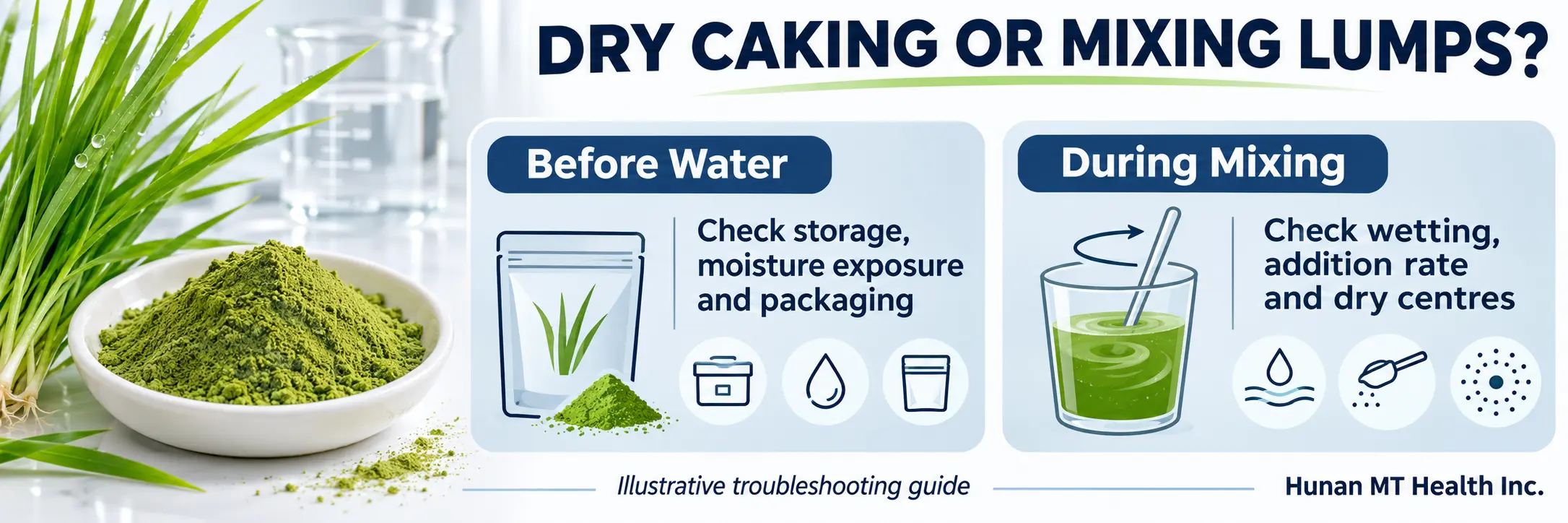
Start before the powder touches water. Does the unopened material contain firm lumps, or do they appear only during preparation?
These are different failure modes.
| Observation | What to investigate |
|---|---|
| Firm lumps already present in the dry powder | Moisture exposure, temperature history, packaging, and compression |
| Loose powder forms floating islands | Wetting behaviour and powder addition rate |
| Wet lumps contain dry centres | Liquid penetration and local hydration |
| Ingredient disperses alone but clumps in the blend | Other ingredients, total solids, and addition sequence |
| Drink mixes initially, then develops sediment | Suspension behaviour rather than initial clumping |
Research on beverage powders shows that temperature and moisture conditions can contribute to storage caking. However, the published study examined cocoa beverage systems; it does not establish the storage limits of barley grass juice powder. [1]
For your own material, compare an unopened retained sample with a repeatedly opened working pack. Record exposure time and storage conditions.
Breaking a cake into smaller pieces may improve handling. It does not explain why it formed, and it should not substitute for a quality review when the material has changed unexpectedly.
1. Powder reaches the liquid faster than it wets
Dumping a full scoop onto a small liquid surface creates a concentrated powder layer. Some particles contact water while others remain surrounded by air or dry material.
Stirring may move that layer around without wetting its centre.
Food-powder rehydration involves wetting, sinking, and dispersion, which need to be assessed separately. Small particle size or an unsuitable particle structure can complicate these stages. [2]
For developers, the practical implication is simple: compare controlled addition with a single dump before changing the ingredient.
2. A hydrated outer layer slows liquid penetration
In a complex drink mix, rapidly hydrating components can create wet outer layers around dry material. This mechanism is particularly relevant when the formula contains gums or other water-binding ingredients.
Treat it as a hypothesis.
Open a lump after a defined mixing period. A dry centre suggests incomplete penetration; a uniformly wet particle cluster points toward a different mechanism. General powder-reconstitution literature describes how hydration and particle association can interfere with dispersion, but those observations are not product-specific results. [2]
Why assume the barley ingredient is responsible if the full blend behaves differently from the ingredient alone?
3. Moisture changes the dry blend before preparation
A working bag left open near steam or handled with a damp scoop can experience different conditions from a sealed reference sample.
Examine packaging and handling. Depending on composition, absorbed moisture may increase particle adhesion and promote caking; beverage-powder research supports investigating these conditions rather than relying on appearance alone. [1]
Measure moisture content or water activity where relevant to your quality protocol. They are different measurements and should not be treated as interchangeable.
4. Other ingredients change the mixing environment
Proteins, fats, fibres, sweeteners, and thickeners can alter the behaviour of a drink mix. A higher total-solids level also leaves less liquid available during the early stages of preparation.
Test the complete formula.
A sample that looks acceptable in water may behave differently in milk, a plant-based beverage, or a thick nutrition shake. Likewise, a blender result does not predict what a customer can achieve with a spoon.
Does the 50:1 Specification Affect Clumping?
A ratio is not a reconstitution specification.
Before comparing 50:1 barley grass juice powder with another grade, confirm the starting material, calculation basis, finished composition, and any carriers. Without that information, a difference in performance cannot be attributed confidently to the ratio.
The same applies to particle size. Finer material is not automatically easier to wet, while larger, deliberately structured agglomerates may behave differently from dense storage lumps.
Hunan MT Health’s 50:1 designation should therefore be considered alongside the technical specification and representative sample. It does not establish a mixing time, a nutritional multiplier, or complete water solubility.
Ask your supplier: “Which properties are measured, and which should we assess in our finished drink?”
That question creates a clearer development brief than requesting a powder that “never clumps.”
A Controlled Trial to Find the Cause
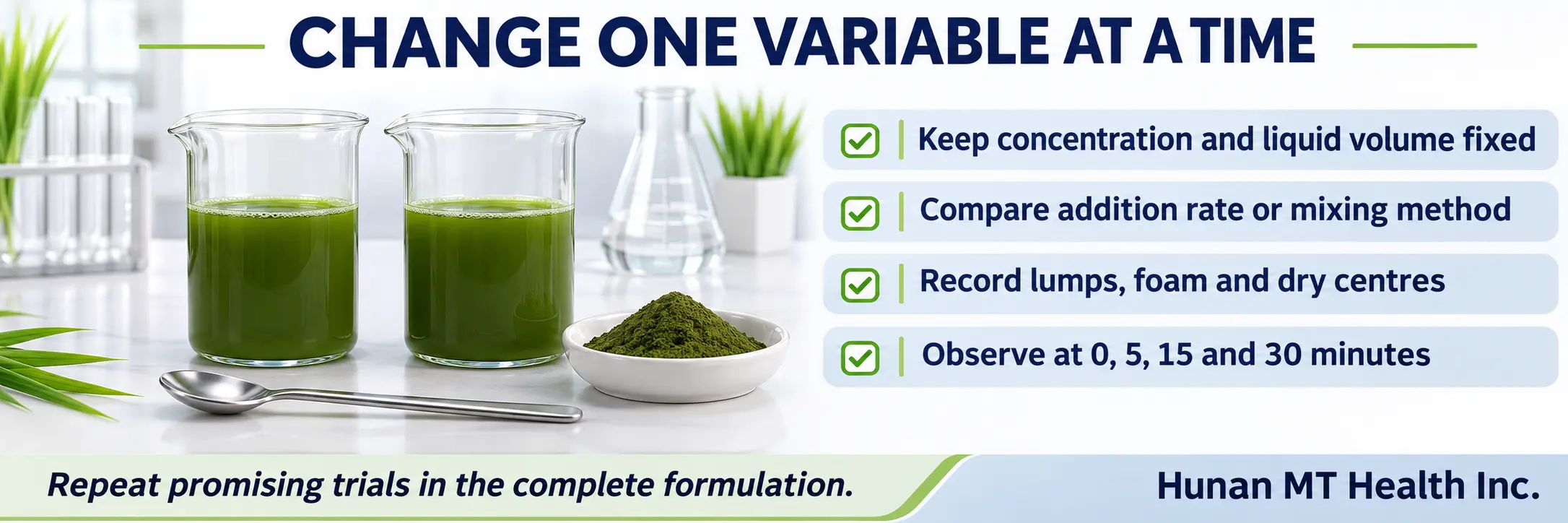
Use one identified batch initially. Keep the powder quantity, final liquid volume, vessel, temperature, and mixing equipment constant unless that variable is being tested.
An illustrative screen could use 2 g of powder in 100 mL of liquid. This is a physical comparison condition—not a recommended serving, validated formula, or consumption instruction.
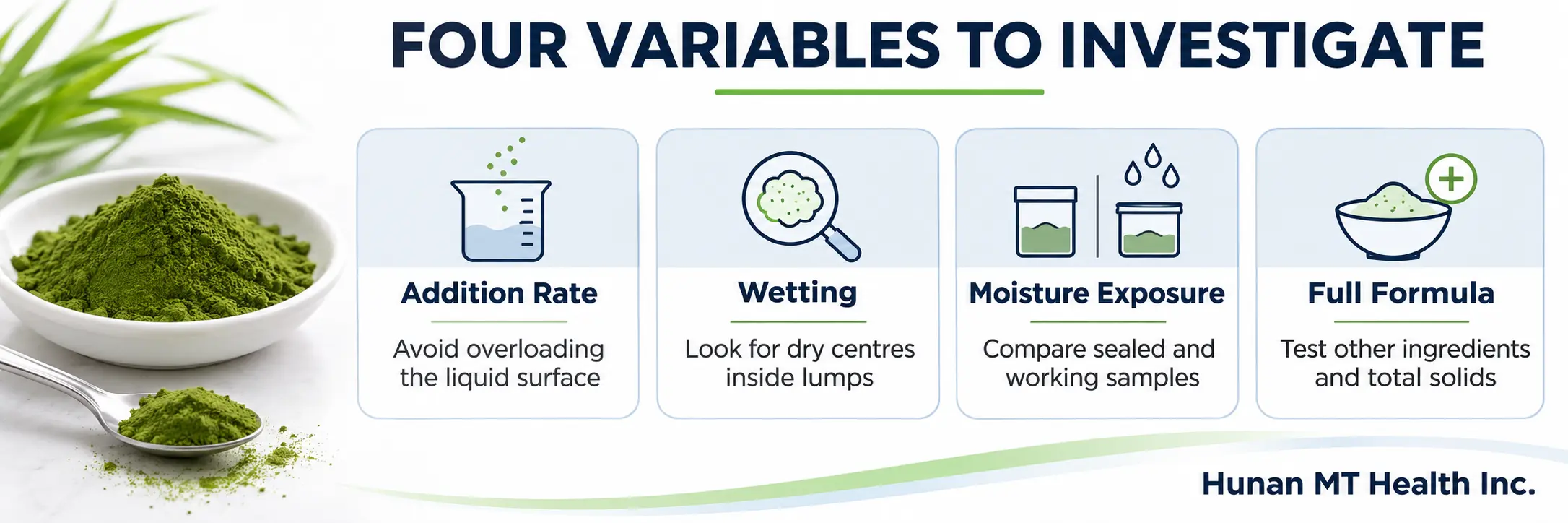
| Trial | Change one variable | What the comparison may reveal |
|---|---|---|
| A: Baseline | Current preparation method | Establishes the problem |
| B: Addition rate | Add gradually instead of all at once | Whether local powder loading contributes |
| C: Formula | Ingredient alone versus complete blend | Whether other ingredients contribute |
| D: Temperature | Compare two measured temperatures | Whether temperature changes the behaviour |
| E: Storage history | Retained sample versus working pack | Whether handling or storage warrants review |
These comparisons suggest causes; they do not prove them individually.
Record the mixing stage
Note floating powder, visible lumps, dry centres, foam, and mixing duration. Photograph samples consistently.
Observe immediately after mixing and at 5, 15, and 30 minutes. Keep later sedimentation separate from the initial clumping score.
Repeat the useful comparison
Once a change appears helpful, repeat it under the same conditions. If possible, have another operator follow the written method.
A result that depends on one person’s interpretation of “stir thoroughly” is difficult to transfer into production or consumer instructions.
Return to the actual product
Finally, test the complete formulation at its intended preparation conditions. Include the relevant processing and holding stages.
Assess taste only after appropriate preparation and suitability for consumption have been confirmed. A physical dispersion screen is not a food-safety assessment.
Choose the next action from the observations.
If gradual addition reduces dry-centred lumps, refine the addition sequence and mixing instructions. For factory preparation, evaluate powder feeding under adequate liquid movement rather than adding powder faster than the system can incorporate it.
Where the complete blend performs poorly but the ingredient alone does not, review the addition order of rapidly hydrating components. A dry preblend or staged hydration may be worth testing, depending on the formula.
Do not apply a universal “use hot water” solution. Temperature can alter hydration, flavour, colour, or other ingredients, so compare measured conditions suitable for the product.
Similarly, increasing shear deserves a controlled trial. More vigorous mixing may reduce lumps while introducing unacceptable foam or other changes.
For persistent storage caking, investigate moisture protection and handling before assuming a finer powder will solve the problem. Any formulation or particle-structure change should be discussed against the actual findings.
Does clumping prove poor ingredient quality?
No. Preparation conditions and the full formulation can contribute. However, unexpected hard lumps in a sealed pack warrant review against the specification, retained sample, and storage history.
Will a shaker bottle always prevent lumps?
No. Its performance depends on the formula, powder loading, liquid volume, and user technique. Test the preparation method your customers will actually use.
Is sediment the same as clumping?
No. Clumping concerns particle clusters, often during initial mixing. Sediment develops when dispersed material settles. A drink can show either problem or both.
Should I switch from 50:1 to 25:1?
Not without a controlled comparison. Confirm composition and ratio definitions, then test both grades against the same acceptance criteria.
Turn the Findings into a Technical Brief
Send the observations, not only a photograph of the final drink. Include the batch code, formula context, liquid temperature, addition sequence, mixing method, and the point at which lumps appear.
Hunan MT Health brings over 20 years of botanical ingredient experience to discussions about sample evaluation, specifications, and customization. Share your test conditions so the team can review the quoted Barley Grass Juice Powder grade and discuss suitable next steps.
Contact marketing@mthealth.com.cn with your trial record. A reproducible problem gives both teams a more useful starting point.
[1] Chávez Montes, E., Ardila Santamaría, N., Gumy, J.-C., and Marchal, P. (2011). Moisture-induced caking of beverage powders. Journal of the Science of Food and Agriculture, 91(14), 2582–2586.
[2] Hogekamp, S., and Schubert, H. (2003). Rehydration of food powders. Food Science and Technology International, 9(3), 223–235.
These references describe general food-powder behaviour. They are not test reports for Hunan MT Health’s Barley Grass Juice Powder.
Author: [Name], [Technical or Product Role], Hunan MT Health Inc.
Technical reviewer: [Name and relevant qualification]
Hunan MT Health try best to understand customer’s needs, predict the market changes, put forward innovative solutions, Adopt creative thinking and advanced technology to improve better service. You are welcome to visit our company any time!
Chat
Leave Your Message
Send your inquiry


 EN_GB
 EN
 ZH
 AR
 TH
 DA
 DE
 ES