Aug 24, 2026
Walk into a modern bubble tea shop in New York, London, Dubai, Singapore, or another major city, and there is a good chance you will find taro bubble tea somewhere on the menu.
Its soft purple appearance immediately stands out. Its creamy texture feels closer to a dessert than a traditional tea. And its mildly sweet, distinctive flavor gives consumers something different from the familiar fruit teas and classic milk teas.
But is taro bubble tea simply another social media trend?
The evidence suggests something more interesting. Taro has moved from a traditional root ingredient into a globally recognizable beverage flavor, and current industry data indicates that taro is one of the fastest-growing flavor segments in bubble tea. Grand View Research projects the taro flavor segment to grow at a 13.9% CAGR from 2026 to 2033.
So, why is taro bubble tea trending worldwide?
The answer lies in a combination of flavor, appearance, cultural influence, beverage innovation, and the convenience of modern taro powder.
Taro bubble tea is a beverage made with taro, a starchy root crop traditionally cultivated and consumed across Asia and the Pacific.
One important botanical distinction is worth making:
Taro is not ube.
Taro generally refers to Colocasia esculenta, while ube is commonly associated with purple yam, particularly 山药. They can look similar in certain processed products, but they are different crops with different flavor and formulation characteristics.
A typical taro bubble tea may combine:
The result is a creamy beverage with a distinctive dessert-like character.
Bubble tea menus are crowded with familiar fruit flavors such as:
Taro occupies a completely different sensory space.
Instead of delivering an acidic, fruity profile, taro generally provides a mild, starchy, creamy and subtly sweet character.
This gives beverage developers another flavor direction:
Not fruit. Not coffee. Not traditional tea. Something in between a beverage and a dessert.
That difference is commercially valuable.
Consumers looking for something new do not necessarily want a completely unfamiliar taste. Taro provides a recognizable creamy profile while still feeling novel to consumers who have never tried it before.
There is another reason taro performs so well in today’s beverage market:
It looks different.
The soft lavender or purple appearance of taro beverages makes them immediately recognizable in photographs and short-form videos.
This matters because beverage discovery increasingly happens visually.
A consumer may see a purple drink on TikTok, Instagram, YouTube Shorts, or a café’s social media page before they know anything about taro itself.
That creates a powerful product-discovery cycle:
See it → become curious → try it → photograph it → share it → introduce it to another consumer.
Current discussions of the 2026 beverage market continue to highlight the appeal of visually distinctive purple drinks and the influence of social media on their popularity.
For beverage brands, this means taro is not only a flavor.
It can also be part of the visual identity of the drink.
Taro did not become popular because of social media alone.
The ingredient has a much longer history.
Taro has been cultivated across parts of Asia and the Pacific for thousands of years and has traditionally been used in both savory and sweet foods. Bubble tea itself emerged in Taiwan in the 1980s before spreading internationally.
When taro entered the expanding bubble tea category, it brought an ingredient with an established culinary identity into a modern beverage format.
This combination is particularly powerful:
Traditional ingredient + contemporary format = new consumer experience.
It allows beverage brands to introduce an Asian-inspired flavor without requiring consumers to understand the ingredient’s entire culinary history before trying it.
One of the most interesting characteristics of taro bubble tea is that it sits between two categories.
It is technically a beverage, but the sensory experience can resemble:
This makes taro particularly suitable for consumers who are not necessarily looking for a traditional tea experience.
The creamy texture and mildly sweet flavor can be paired with:
This creates a wide range of formulation possibilities for cafés and beverage manufacturers.
Fresh taro is a perishable agricultural ingredient. For commercial beverage production, handling fresh root at every location can create challenges related to:
Taro powder offers a more convenient ingredient format.
Depending on the manufacturing process and product specification, powdered taro can provide a standardized dry ingredient that is easier to transport, store, measure, and incorporate into beverage formulations.
For cafés and food manufacturers, this can simplify product development.
Instead of preparing fresh taro for every serving, a powdered ingredient can be incorporated into a controlled beverage recipe.
This is particularly relevant to:
A successful beverage trend needs to be more than a single recipe.
Taro has an advantage because it can be combined with many familiar ingredients.
The classic combination creates a creamy and dessert-like beverage.
Coconut can reinforce the tropical character of the drink.
Taro can be incorporated into latte-style concepts for consumers looking for something different from traditional vanilla or caramel.
Black tea and green tea can provide additional flavor complexity.
Chocolate and taro can create a richer dessert-style profile.
Oat, coconut, almond, and other alternatives can be used to develop dairy-free beverage concepts.
This adaptability gives manufacturers more room for menu innovation and seasonal product development.
The commercial opportunity is not limited to traditional boba shops.
The growing interest in taro is creating opportunities across a wider range of food and beverage categories.
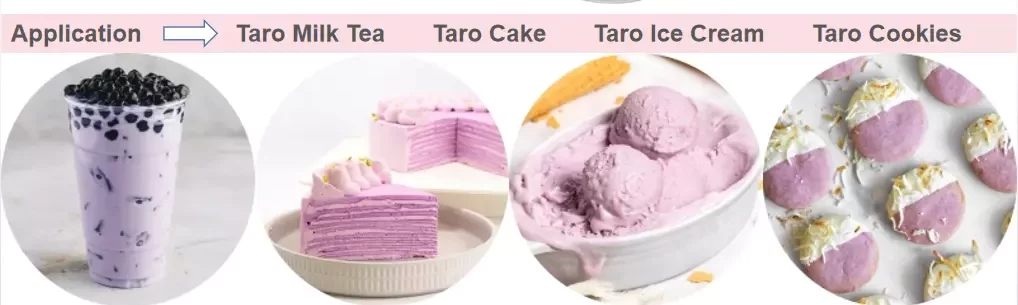
A café-style beverage that positions taro alongside coffee and other specialty latte flavors.
Taro can be combined with milk or plant-based beverages to create a thicker drink.
Its creamy flavor profile makes taro suitable for frozen desserts.
Potential applications include:
Powdered taro can also be incorporated into instant dessert formulations.
This is particularly relevant for manufacturers developing convenient consumer products.
The expansion from one beverage category into multiple applications is one reason taro has potential beyond a temporary bubble tea craze.
Bubble tea itself has become an international beverage category rather than a niche product associated only with its Taiwanese origins.
Industry research indicates that the taro flavor segment is expected to be one of the fastest-growing flavor categories within bubble tea through the early 2030s.
Another 2026 industry report points to strong buyer interest in taro powder and identifies international markets including the United States, Ghana, and Saudi Arabia among markets showing notable sourcing interest.
These developments are important for ingredient suppliers.
The opportunity is no longer simply:
“Can we sell taro bubble tea?”
It is increasingly:
“How can taro become a scalable ingredient platform for international beverage innovation?”
For commercial production, the choice between fresh taro and powdered taro depends on the product and processing system.
| Factor | Fresh Taro | 芋头粉 |
|---|---|---|
| 存储 | More demanding | Generally easier to store |
| Transportation | Heavier and perishable | More convenient dry format |
| Processing | Requires preparation | Ready for formulation |
| Dosage | Less standardized | Easier to measure |
| Foodservice operation | More labor-intensive | More convenient |
| Large-scale production | Requires additional processing | Better suited to dry ingredient systems |
| Shelf-life management | Requires greater control | Easier when properly packaged |
This does not mean powder is always better.
For some premium products, fresh taro may be part of the desired consumer experience.
For large-scale, standardized, or instant beverage production, however, powder can provide significant operational advantages.
This is one area where consumers and manufacturers should be careful.
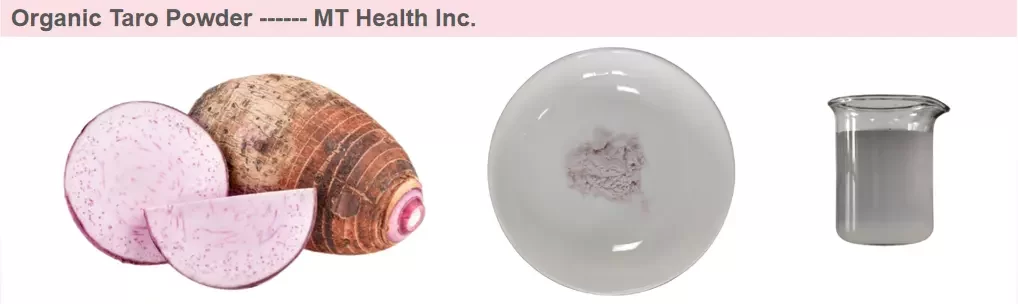
Real taro is not necessarily the intensely purple color commonly associated with commercial taro bubble tea.
The flesh of many taro varieties can be white, cream, or pale with purple flecks. The final color of a commercial beverage can be influenced by:
Commercial taro powders can therefore produce different shades depending on their formulation and specifications.
For B2B buyers, this makes it important to distinguish between pure taro powder and formulated taro beverage mixes.
For manufacturers, the attraction of taro is not simply consumer curiosity.
It offers several practical product-development opportunities.
Taro provides an alternative to highly saturated fruit and dessert flavors.
Purple or lavender beverages can stand out on café menus and social media.
One ingredient can support multiple beverage concepts.
Taro works naturally with milk, plant-based milk, tea, coffee, and dessert-style formats.
For industrial and foodservice applications, powder can simplify storage, transportation, and formulation.
taro flavor description
At Hunan MT Health, we recognize that the global popularity of taro is creating opportunities well beyond traditional bubble tea.
我们的 芋头粉 can be considered for B2B applications including:
As a botanical ingredient supplier, we focus on helping manufacturers identify the appropriate ingredient specification for their intended application.
For larger projects, buyers can discuss requirements such as:
If you are developing a taro bubble tea, instant beverage, taro latte, dessert, ice cream, bakery product, or other food application, Hunan MT Health can provide B2B taro powder solutions for commercial product development.
Contact Hunan MT Health to discuss your application, request a sample, review product specifications, or receive a bulk quotation.
From traditional root crops to modern global beverages, taro is giving food and beverage brands a new way to create products consumers want to see—and taste.
湖南 MT Health 努力了解客户需求,预测市场变化,提出创新解决方案,采用创造性思维和先进技术来改进更好的服务。欢迎您随时莅临我公司参观指导!
聊天
留言
发送查询


 ZH
ZH  EN
EN  AR
AR  TH
TH  EN_GB
EN_GB  DA
DA  DE
DE  ES
ES