Aug 28, 2026
When sourcing turmeric extract for supplements, functional foods, beverages, cosmetics, or botanical formulations, one question frequently comes up:
Should you buy turmeric extract from China or India?
India is traditionally associated with turmeric cultivation and has a strong reputation for turmeric as an agricultural and culinary ingredient. China, meanwhile, has developed a large botanical-extract manufacturing sector with extensive experience in extraction, purification, standardization, testing, and international B2B supply.
For buyers, the decision is therefore more complicated than simply comparing the country of origin.
A better purchasing question is:
Which supplier can provide the right turmeric extract specification, consistent quality, appropriate certifications, reliable testing, and competitive total cost for my application?
This article compares China vs. India turmeric extract suppliers from the perspective of price, quality, certification, manufacturing, testing, and B2B purchasing.
China vs. India Turmeric Extract: The Short Answer
There is no universal winner.
India has a major advantage in turmeric’s agricultural heritage and raw-material ecosystem. China has a strong advantage in large-scale ingredient processing, manufacturing flexibility, and highly developed export-oriented botanical extract supply chains.
Both countries have manufacturers offering standardized turmeric extracts, including products with high curcuminoid concentrations.
For example, Indian suppliers currently advertise turmeric extracts ranging from approximately 35% to 95% curcuminoids, while Chinese suppliers commonly offer specifications ranging from lower-concentration turmeric extracts to 95% curcumin products.
The most important distinction is therefore supplier-specific quality rather than country alone.
A strong Indian manufacturer can outperform a weak Chinese supplier, and a well-managed Chinese manufacturer can outperform a poorly controlled Indian supplier.
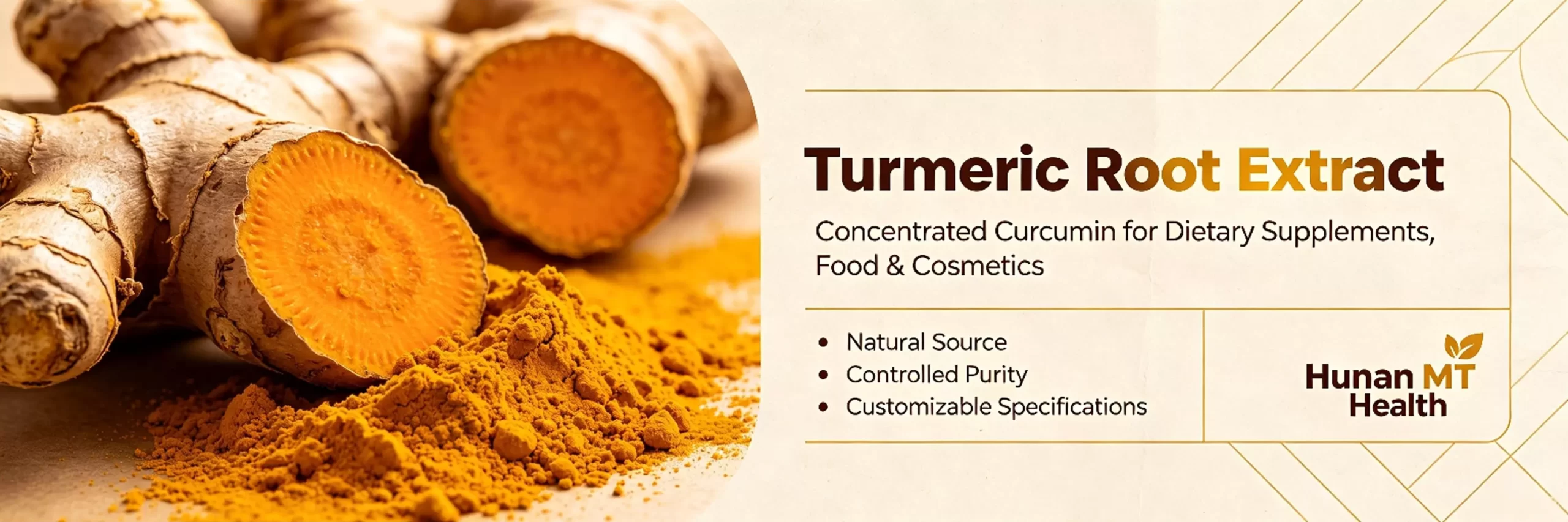
India has a long-established turmeric cultivation and processing industry.
Turmeric, botanically known as Curcuma longa, has been cultivated and used extensively in India for generations. The country’s agricultural ecosystem gives Indian suppliers direct access to major turmeric-growing regions and established raw-material networks.
For buyers interested in turmeric origin and agricultural traceability, this can be an important advantage.
Indian manufacturers can source turmeric from established domestic supply chains before extracting and standardizing the raw material.
This is particularly relevant when the product positioning emphasizes:
Indian turmeric
Origin-specific turmeric
Organic turmeric
Traditional turmeric sourcing
Agricultural traceability
However, raw-material origin alone does not determine the quality of the finished extract.
A turmeric rhizome still needs appropriate:
身份验证
Cleaning
存储
Testing
Extraction
Purification
Standardization
before it becomes a commercial botanical extract.
China has developed a large export-oriented botanical ingredient industry.
For turmeric extract, Chinese manufacturers can provide different standardized specifications and formats according to application requirements.
Examples found in current supplier listings include:
10% curcuminoids
30% curcuminoids
50% curcuminoids
95% curcuminoids
Water-dispersible turmeric ingredients
Customized formulations
Chinese suppliers also commonly provide HPLC testing and documentation for B2B customers.
Some Chinese manufacturers advertise certifications including:
ISO 9001
ISO 22000
HACCP
FSSC 22000
清真
犹太
GMP
Organic certification
The exact certifications vary by supplier and product, so buyers should verify certificates rather than assuming that every Chinese supplier has the same qualifications.
Price is one of the first factors considered by B2B buyers.
However, comparing turmeric extract prices is difficult because “turmeric extract” can describe products with very different specifications.
For example, a 10% curcuminoid extract and a 95% curcumin product should not be compared on a simple price-per-kilogram basis.
Current online supplier listings illustrate this wide range.
Chinese marketplace listings show 95% curcumin products offered at prices ranging from roughly tens of U.S. dollars per kilogram to higher levels depending on supplier, certification, specification, quantity, and product positioning. One current Chinese supplier listing, for example, shows 95% turmeric extract at about US$55/kg for smaller bulk quantities and US$52.50/kg at 500 kg or more.
Indian listings also show substantial variation. One Indian supplier currently lists 95% curcumin powder at approximately ₹5,200/kg with a 100 kg MOQ, while another listing shows 95% curcumin extract at approximately ₹7,800/kg with a 100 kg MOQ.
These numbers should not be treated as fixed China-versus-India market prices.
They demonstrate an important purchasing principle:
Turmeric extract price depends more on specification and supplier conditions than on country alone.
Factors include:
Curcuminoid concentration
Extraction technology
Raw-material cost
Organic status
Certification
Testing requirements
Packaging
Order volume
定制
Shipping
Payment terms
A supplier offering the lowest FOB price may not necessarily be the cheapest supplier for your project.
B2B buyers should consider total landed cost.
This can include:
Product price + testing + packaging + freight + customs + documentation + inspection + inventory cost + potential quality-loss risk
For example, if a low-cost product has inconsistent curcuminoid content, the buyer may need additional testing or reject a batch.
That can be much more expensive than paying a slightly higher price to a supplier with reliable batch consistency.
Therefore, the better question is not:
“Who offers the cheapest turmeric extract?”
It is:
“Who provides the best total value for my required specification?”
For turmeric extract, one of the most important quality indicators is standardized curcuminoid content.
Curcuminoids are the major group of compounds commonly used to characterize concentrated turmeric extracts.
A commercial product may be standardized to a specific percentage, such as 10%, 30%, 50%, or 95%, depending on its intended application.
HPLC is widely used to quantify these compounds.
Indian suppliers advertise HPLC-tested turmeric extracts, while Chinese manufacturers also commonly specify HPLC or HPLC/UV testing for commercial turmeric extract products.
For buyers, the critical question is:
Does the batch actually meet the specification stated on the COA?
That is more meaningful than simply asking whether the supplier is from China or India.
A professional turmeric extract purchasing process should include analytical verification.
For standardized curcuminoid products, buyers should look for appropriate analytical testing such as:
Total curcuminoids
Curcumin
Demethoxycurcumin
Bisdemethoxycurcumin
The exact analytical specification depends on the product.
A supplier should be able to provide a Certificate of Analysis (COA) corresponding to the batch being supplied.
For larger or higher-value orders, buyers may also consider independent laboratory verification.
This creates a stronger quality-control chain:
Supplier testing → COA → Customer verification → Batch acceptance
Potency is only one part of turmeric extract quality.
International buyers should also consider potential contaminants, particularly when products are intended for food or supplement markets.
Depending on the target market, relevant testing can include:
重金属
Pesticide residues
Microbiology
Residual solvents
Mycotoxins
Other market-specific contaminants
The European Commission maintains controls for contaminants in food, including heavy metals, mycotoxins, plant toxins, and other contaminants. The EU also maintains a pesticide database containing information on active substances and maximum residue levels.
This means that a supplier’s ability to provide batch-specific analytical documentation can be more important than simply displaying a generic “high quality” statement.
It would be inaccurate to say that one country universally has better certifications.
Both China and India have suppliers with extensive certification portfolios.
Indian turmeric extract manufacturers currently advertise combinations such as:
ISO 9001 + FSSC 22000 + Halal + Kosher + CGMP
for selected turmeric extract products.
Chinese manufacturers similarly advertise combinations including:
ISO 9001 + ISO 22000 + HACCP + FSSC 22000 + Halal + Kosher + GMP
depending on the facility and product.
Therefore, the right approach is to evaluate the actual certificate, certificate holder, facility, scope, validity, and applicable product category.
Certifications should not simply be treated as marketing badges.
Each certification has a different purpose.
ISO 9001
Focuses on quality management systems.
ISO 22000
Focuses on food safety management systems.
HACCP
Focuses on identifying and controlling food safety hazards.
FSSC 22000
Provides a broader food safety management certification framework used extensively in the food industry.
GMP
Focuses on controlled manufacturing practices and is particularly relevant to pharmaceutical, nutraceutical, and certain food ingredient applications.
清真
Important for products intended for halal markets.
犹太
Important for customers requiring kosher-compliant ingredients.
Organic Certification
Relevant when the product is marketed as certified organic.
The important point is:
Certification should match the intended application and destination market.
A supplier having ten certificates does not automatically mean every product it sells is covered by all ten certificates.
Another important difference for B2B buyers is manufacturing flexibility.
Indian manufacturers with strong turmeric expertise may have particular advantages in:
Turmeric sourcing
Origin-specific products
Traditional botanical supply
Standardized curcumin extracts
Organic turmeric
Chinese botanical extract manufacturers often emphasize:
Multiple extract specifications
定制
Different powder formats
Bulk production
OEM/ODM
Export packaging
Integrated testing
For example, Chinese suppliers currently advertise turmeric extract specifications from lower concentrations to 95% curcuminoids and customized water-dispersible forms.
For product developers, this flexibility can be important when the application is not a standard capsule or powder.
India may be particularly attractive when your project emphasizes:
Indian-origin turmeric
Agricultural traceability
Organic turmeric sourcing
Traditional turmeric positioning
Origin-specific raw materials
Suppliers deeply focused on turmeric
For brands where India-origin storytelling is part of the finished product’s marketing strategy, an Indian supplier can provide a natural fit.
China may be particularly attractive when the project prioritizes:
Competitive bulk pricing
Multiple specifications
Customized powder formats
Flexible MOQs
Export-oriented production
Broad botanical ingredient sourcing
Integrated quality testing
B2B manufacturing support
For manufacturers developing multiple botanical products rather than only turmeric, China can also offer the advantage of sourcing several ingredients through an established botanical-extract supply chain.
For B2B buyers comparing China and India, Hunan MT Health represents the Chinese manufacturing option with a focus on botanical extracts and international ingredient supply.
Our Turmeric Extract is available in standardized specifications for different formulation requirements, with quality control and documentation designed for B2B customers.
For buyers evaluating a supplier, we recommend focusing on the complete package:
Specification + COA + Testing + Certification + Batch Consistency + Supply Capacity + Price
rather than evaluating a supplier based on country alone.
Hunan MT Health can support customers with product information, samples, specifications, COA documentation, and bulk supply discussions according to project requirements.
Before placing a commercial turmeric extract order, ask both Chinese and Indian suppliers the same questions.
1. What is the botanical source?
Confirm Curcuma longa L. and the plant part used.
2. What is the standardized curcuminoid content?
Ask for the exact specification rather than simply “turmeric extract.”
3. How is the active content tested?
For standardized products, ask whether HPLC is used and request the analytical method where appropriate.
4. Can you provide a batch-specific COA?
A current COA is more useful than a generic product brochure.
5. What contaminants are tested?
Ask about heavy metals, pesticides, microbiology, residual solvents, and other requirements relevant to your market.
6. Which certifications actually cover this product?
Verify the scope and validity of certifications.
7. Can you provide a representative sample?
Always test the ingredient in your actual formulation before committing to a large commercial order.
There is no simple country-level answer.
India has an undeniable advantage in turmeric cultivation, agricultural heritage, and origin-specific sourcing.
China has developed a highly competitive botanical extract manufacturing and export ecosystem with broad specification, processing, testing, and customization capabilities.
Both countries have suppliers capable of producing high-quality standardized turmeric extract.
For professional B2B procurement, the final decision should therefore be based on:
Product specification → analytical results → certification → contaminant control → batch consistency → manufacturing capability → logistics → total landed cost
rather than nationality alone.
In other words:
The best turmeric extract supplier is not necessarily the supplier from the “better” country. It is the supplier that can consistently deliver the specification your product actually requires.
If you are comparing China vs. India turmeric extract suppliers for a new supplement, functional food, beverage, cosmetic, or botanical formulation, Hunan MT Health can provide product specifications and samples for evaluation.
Our team can discuss:
Turmeric Extract specifications
Curcuminoid concentration
HPLC testing
COA
Quality documentation
Certification requirements
Packaging
MOQ
Bulk quotation
International shipment requirements
Request a sample and compare the actual product—not just the supplier’s country, price, or marketing claims.
That is the most reliable way to determine which turmeric extract supplier is the right fit for your business.
湖南 MT Health 努力了解客户需求,预测市场变化,提出创新解决方案,采用创造性思维和先进技术来改进更好的服务。欢迎您随时莅临我公司参观指导!
聊天
留言
发送查询


 ZH
ZH  EN
EN  AR
AR  TH
TH  EN_GB
EN_GB  DA
DA  DE
DE  ES
ES