Aug 27, 2026
Watermelon is one of the world’s most recognizable summer fruits. Its refreshing taste, naturally sweet profile, and familiar fruit aroma have made it a popular ingredient in beverages, desserts, snacks, and fruit-based formulations.
But turning fresh watermelon into a high-quality watermelon powder is more complicated than simply drying the fruit and grinding it.
For food and beverage manufacturers, the real question is not just “Is it watermelon powder?” but:
What makes one watermelon powder better suited to commercial applications than another?
The answer involves raw material quality, processing technology, moisture control, color, aroma, particle characteristics, microbiological quality, packaging, and—most importantly—how the powder performs in the finished product.
For B2B buyers, understanding these factors can make a significant difference when selecting a watermelon powder supplier.
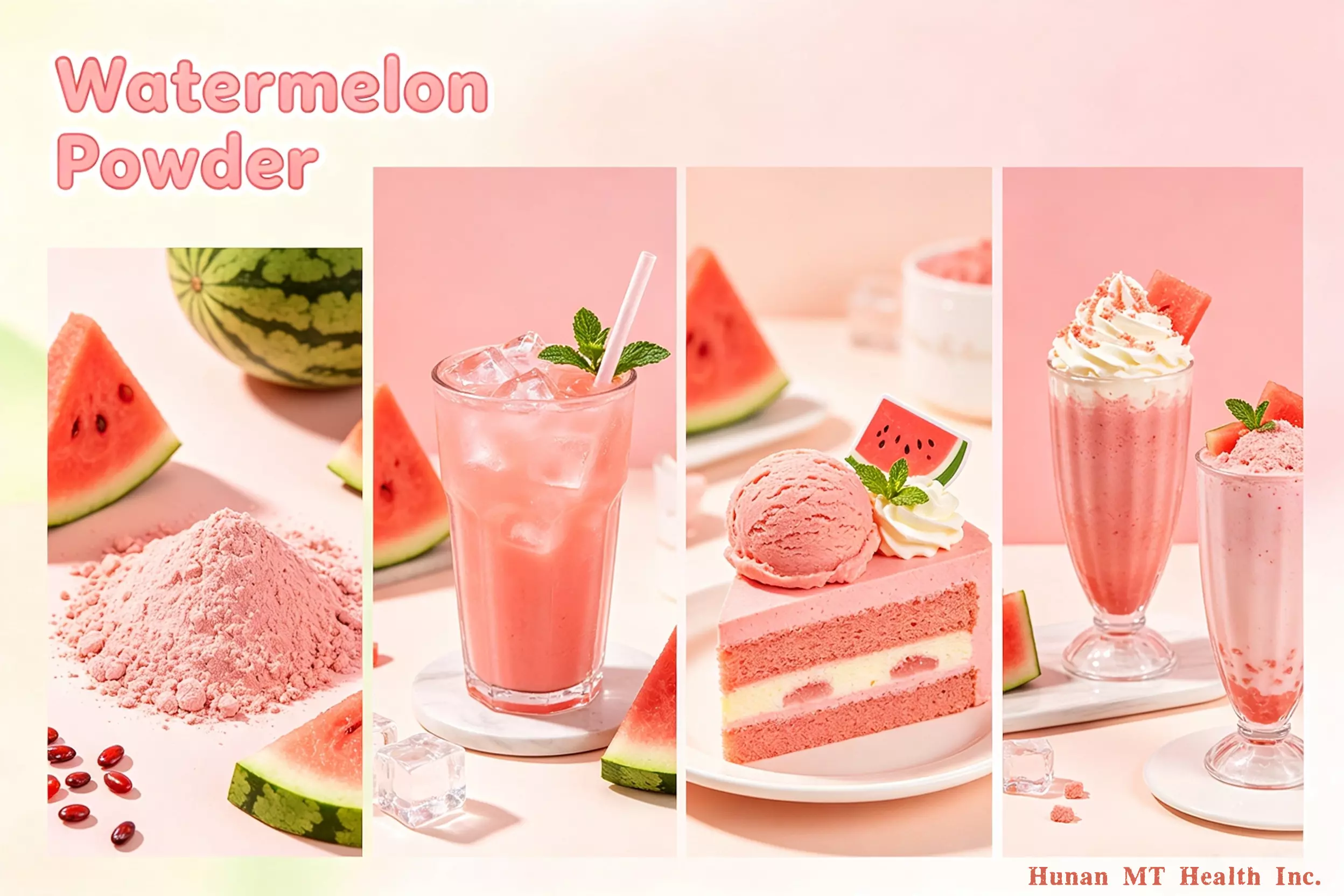
Watermelon powder is a dried watermelon-based ingredient produced by removing most of the water from watermelon and processing the resulting material into a powder.
Fresh watermelon contains a very high proportion of water. This makes fresh fruit refreshing and juicy, but it also creates challenges for transportation, storage, and industrial formulation.
Converting watermelon into a dry powder can provide a more convenient ingredient format for food manufacturers.
Depending on the production process and specification, watermelon powder may be used in:
However, not every product sold as “watermelon powder” has exactly the same composition or processing characteristics.
Some products are made from watermelon fruit itself, while others may be formulated with carriers, sweeteners, flavors, or other ingredients.
Therefore, ingredient transparency is one of the first things B2B buyers should examine.
The quality of the final powder cannot be completely separated from the quality of the raw watermelon.
Fresh watermelon naturally varies according to:
Variety
Growing conditions
Maturity
Harvest timing
Agricultural practices
Storage conditions
These factors can influence the fruit’s:
Flavor
Aroma
Color
Moisture
Soluble solids
For powder production, raw-material selection is particularly important because drying does not magically improve poor-quality fruit.
A manufacturer aiming for a consistent watermelon ingredient should therefore have appropriate controls over incoming raw materials.
Why maturity matters
Watermelon harvested at an appropriate stage of maturity can provide a more desirable fruit flavor and sweetness profile.
Fruit that is immature may have a weaker flavor, while overripe raw material may present different processing and quality challenges.
For B2B buyers, asking about raw-material specifications and quality control is a reasonable part of supplier evaluation.
Watermelon is a challenging fruit to process because of its high water content and relatively low proportion of dry solids.
The drying method therefore matters.
Industrial fruit powders may be produced using technologies such as:
Spray drying
Freeze drying
Other controlled dehydration processes
Each approach can influence the characteristics of the final powder.
Spray-Dried Watermelon Powder
Spray drying is widely used in the food ingredient industry to convert liquid or slurry-based materials into powders.
The process can offer advantages for:
Large-scale production
Consistent powder production
Controlled moisture
Convenient handling
Industrial formulation
Because watermelon has a high water content and can be difficult to turn into a free-flowing powder on its own, carriers may sometimes be used depending on the formulation and manufacturing process.
This is why buyers should always check the complete ingredient declaration rather than assuming every watermelon powder is 100% watermelon solids.
Freeze-Dried Watermelon Powder
Freeze drying removes water under low-temperature and reduced-pressure conditions.
This approach can help preserve certain characteristics of the original fruit, but it can also involve higher processing costs.
For some premium applications, manufacturers may consider freeze-dried fruit powders where the desired sensory profile and processing requirements justify the cost.
The “best” drying technology therefore depends on the application.
High quality does not mean one universal processing method.
It means the manufacturing process is appropriate for the intended product.
Watermelon is strongly associated with its pink-to-red fruit color.
As a result, color is an important consideration when evaluating watermelon powder.
A good powder should have a color that is reasonably consistent with its raw material and processing specification.
However, buyers should avoid judging quality based solely on how bright or intense the powder looks.
Color can be influenced by:
Watermelon variety
Fruit maturity
Processing conditions
Drying temperature
Oxidation
Concentration
Added ingredients or carriers
A very bright red or pink powder is not automatically a better watermelon powder.
The more useful question is:
Does the color meet the agreed specification and remain suitable in the intended application?
For manufacturers developing beverages or desserts, application testing is essential because the powder’s appearance can change after dilution or blending.
A watermelon powder may look attractive but still fail a formulation test if its flavor is weak or unbalanced.
High-quality fruit powder should have a characteristic watermelon sensory profile appropriate to its specification.
B2B buyers should evaluate:
Aroma
Sweetness perception
Fruit character
Off-notes
Aftertaste
Flavor intensity
This is particularly important for beverage manufacturers.
A powder that smells strongly of watermelon in the bag may not deliver the same intensity once diluted in a finished beverage.
Therefore, sensory evaluation should ideally take place in the actual target formulation, not just by tasting the dry powder.
Moisture is one of the most important technical considerations for powdered ingredients.
If a powder absorbs excessive moisture during production, transportation, or storage, it can become more difficult to handle.
Potential issues include:
Caking
Poor flowability
Changes in texture
Reduced dispersibility
Increased risk of quality deterioration
For this reason, manufacturers should establish appropriate moisture specifications for watermelon powder.
But moisture control does not stop at the factory.
Packaging also matters.
A well-manufactured powder can still experience quality problems if it is exposed to excessive humidity after production.
Good powder quality requires both good processing and good storage management.
Particle size may sound like a minor technical detail, but it can influence how a powder behaves during production.
Depending on the application, manufacturers may care about:
Powder flow
Mixing
Dispersion
Dissolution
Mouthfeel
Dusting
Blending uniformity
For example, a beverage manufacturer may have different requirements from a bakery manufacturer.
A powder intended for a dry beverage mix may need to disperse efficiently, while a bakery formulation may prioritize blending characteristics.
This is why B2B buyers should not simply ask:
“What is the particle size?”
A better question is:
“What particle characteristics are appropriate for my application?”
This is particularly important for watermelon beverage applications.
A powder may be described as soluble or dispersible, but actual performance can depend on the complete formulation.
Factors such as:
Water temperature
Powder concentration
pH
Sugar content
Other fruit powders
Proteins
Fibers
Minerals
Processing conditions
can influence the final behavior.
Therefore, manufacturers should conduct application testing before commercial-scale purchasing.
For a watermelon beverage, for example, it is useful to test:
Dry powder → water → complete beverage formula → storage → sensory evaluation
This provides much more practical information than evaluating the powder alone.
Today’s B2B buyers increasingly pay attention to ingredient declarations.
When evaluating watermelon powder, manufacturers should determine exactly what they are purchasing.
Is it:
Watermelon fruit powder?
Watermelon juice powder?
Watermelon extract?
A watermelon-flavored powder?
A blend containing watermelon powder?
A powder with a carrier?
These products may have very different formulation characteristics.
For food manufacturers, clear labeling and transparent specifications are essential for product development and regulatory review.
The ingredient declaration should therefore be examined carefully before placing a large order.
Fruit-derived ingredients require appropriate microbiological controls.
Because watermelon is an agricultural raw material, manufacturers should consider relevant quality parameters such as:
Total plate count
Yeast and mold
Coliforms
Pathogen specifications where applicable
The exact requirements depend on:
Product specification
Intended application
Target market
Local food regulations
A professional B2B supplier should be able to provide relevant quality documentation for the product being supplied.
For commercial buyers, a Certificate of Analysis (COA) can be an important part of incoming-material verification.
It is easy to focus on the powder itself and forget about packaging.
For fruit powders, packaging plays an important role in protecting the product from:
Moisture
Oxygen
Light
Contamination
Physical damage
The appropriate packaging format depends on the product specification, intended shelf life, transportation conditions, and customer requirements.
For international B2B shipments, packaging also needs to withstand:
Long-distance transportation
Temperature fluctuations
Humidity
Repeated handling
In other words:
A high-quality ingredient needs high-quality protection.
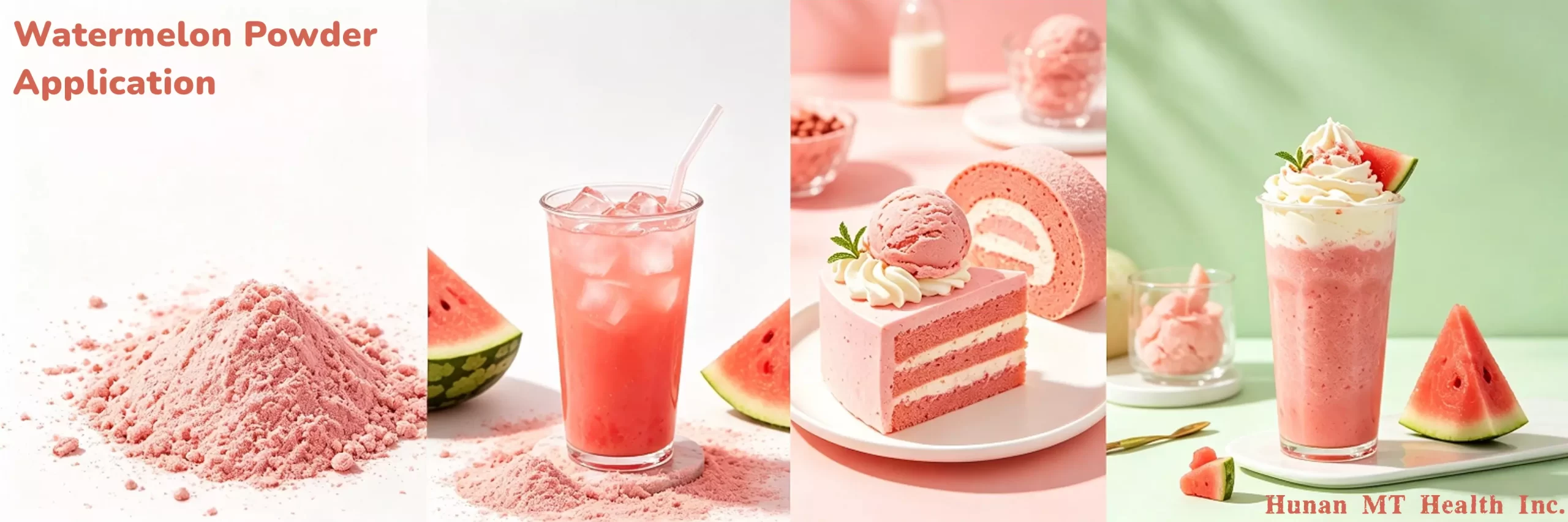
The versatility of watermelon powder is another reason manufacturers are interested in it.
Beverage Applications
Potential uses include:
Instant fruit drinks
Smoothie powders
Flavored beverages
Fruit drink mixes
Beverage premixes
Dairy and Dairy Alternatives
Watermelon powder can be explored in:
Yogurt formulations
Dairy drinks
Plant-based beverages
Frozen dairy desserts
Bakery
Possible applications include:
Cakes
Cookies
Muffins
Pancakes
Bakery premixes
Desserts
Watermelon powder can be incorporated into:
Ice cream
Sorbet
Dessert mixes
Pudding-style products
Nutritional Products
Depending on the specification, fruit powders can also be considered for:
Nutrition blends
Smoothie formulations
Powdered wellness products
Application suitability should always be verified against the specific product specification and regulatory requirements.
A practical purchasing checklist can help avoid quality problems.
Step 1: Check the Ingredient Declaration
Understand exactly what is in the product.
Step 2: Review the Specification
Look at parameters such as:
外观
Moisture
Particle size
Flavor
Microbiological limits
Other relevant quality indicators
Step 3: Request a Sample
Never rely exclusively on product photographs or descriptions.
Step 4: Test the Powder in Your Formula
Evaluate it under real production conditions.
Step 5: Review Documentation
Ask for relevant:
COA
Product specification
Microbiological data
Allergen information where applicable
Other market-specific documentation
Step 6: Evaluate Supplier Consistency
For long-term supply, ask how the supplier manages:
Raw materials
Batch consistency
Quality control
Production capacity
Packaging
Delivery
A competitive price is useful, but consistent quality is usually more valuable for a long-term manufacturing relationship.
At Hunan MT Health, we provide fruit powders and botanical ingredients for B2B food and beverage applications.
Our Watermelon Powder can be considered for manufacturers developing:
Fruit beverages
Instant drink mixes
Smoothies
Desserts
Ice cream
Bakery products
Yogurt products
Food premixes
Other fruit-based formulations
We understand that different customers may have different requirements.
A beverage manufacturer may prioritize dispersion and flavor.
A bakery producer may focus on blending and processing stability.
A distributor may prioritize specifications, packaging, shelf life, and supply consistency.
For B2B customers, we can support discussions around:
Product specifications · Samples · COA · Packaging · Application requirements · Bulk supply
The goal is to provide an ingredient that fits the customer’s actual formulation rather than simply offering a generic fruit powder.
A high-quality watermelon powder is not defined by color alone.
It is not simply the powder with the strongest aroma, the lowest price, or the brightest appearance.
For professional food manufacturers, quality is a combination of:
Good raw materials + appropriate processing + controlled moisture + consistent flavor + suitable particle characteristics + microbiological control + protective packaging + reliable documentation.
Most importantly, the powder needs to perform consistently in the finished product.
That is the standard B2B buyers should use when comparing suppliers.
Hunan MT Health supplies Watermelon Powder for food and beverage manufacturers, ingredient distributors, and product developers.
If you are developing a new fruit beverage, smoothie, dessert, bakery product, or powdered food formulation, contact us to discuss your requirements.
We can provide product specifications, samples, COA, technical information, and bulk quotation options based on your project.
The right watermelon powder is not simply an ingredient. It is a formulation tool that can help manufacturers bring watermelon flavor and fruit identity into modern food products in a more convenient dry format.
湖南 MT Health 努力了解客户需求,预测市场变化,提出创新解决方案,采用创造性思维和先进技术来改进更好的服务。欢迎您随时莅临我公司参观指导!
聊天
留言
发送查询


 ZH
ZH  EN
EN  AR
AR  TH
TH  EN_GB
EN_GB  DA
DA  DE
DE  ES
ES