Sep 1, 2026
Reishi mushroom has become an increasingly important ingredient in the global functional mushroom market. Known scientifically as Ganoderma lucidum and commonly referred to as Lingzhi, reishi has a long history of use in traditional Asian food and herbal practices.
Today, reishi is no longer limited to traditional preparations. Reishi extracts are being developed for functional foods, beverages, dietary supplements, mushroom blends, and other botanical formulations.
But one technical question matters greatly when sourcing a reishi extract:
Is water extraction or alcohol extraction better for reishi?
The answer is not as simple as choosing one solvent over the other.
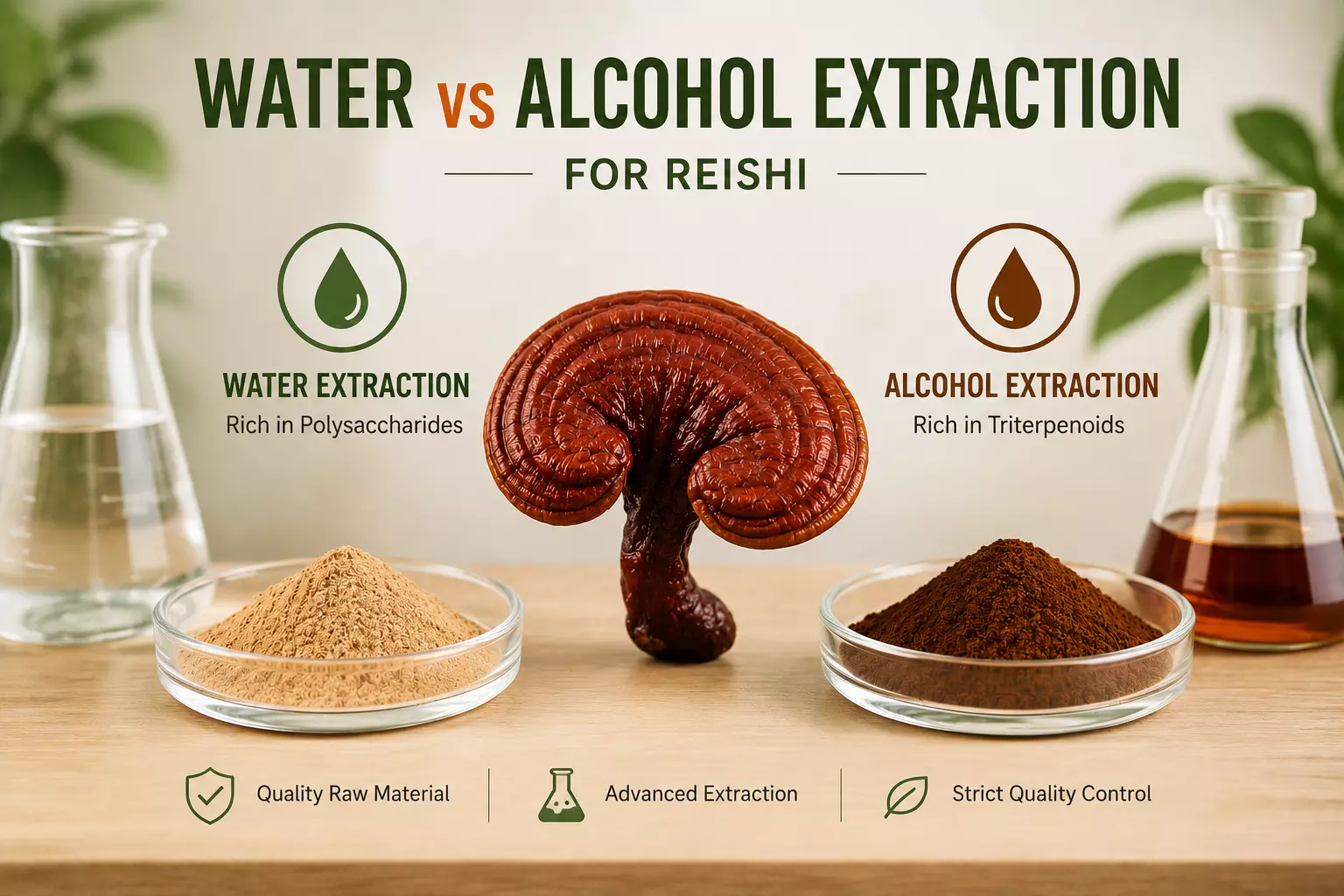
Reishi contains a complex mixture of compounds with different chemical properties. Among the most studied groups are polysaccharides and triterpenoids. These compounds do not behave the same way during extraction.
Water is particularly suitable for extracting many water-soluble polysaccharides, while ethanol-based extraction can be more effective for many less-polar compounds, including triterpenoids. Recent reviews of Ganoderma lucidum extraction specifically highlight this difference and suggest that extraction method strongly influences the composition of the resulting extract.
For B2B buyers, therefore, the better question is:
What type of reishi extract do you need for your application?
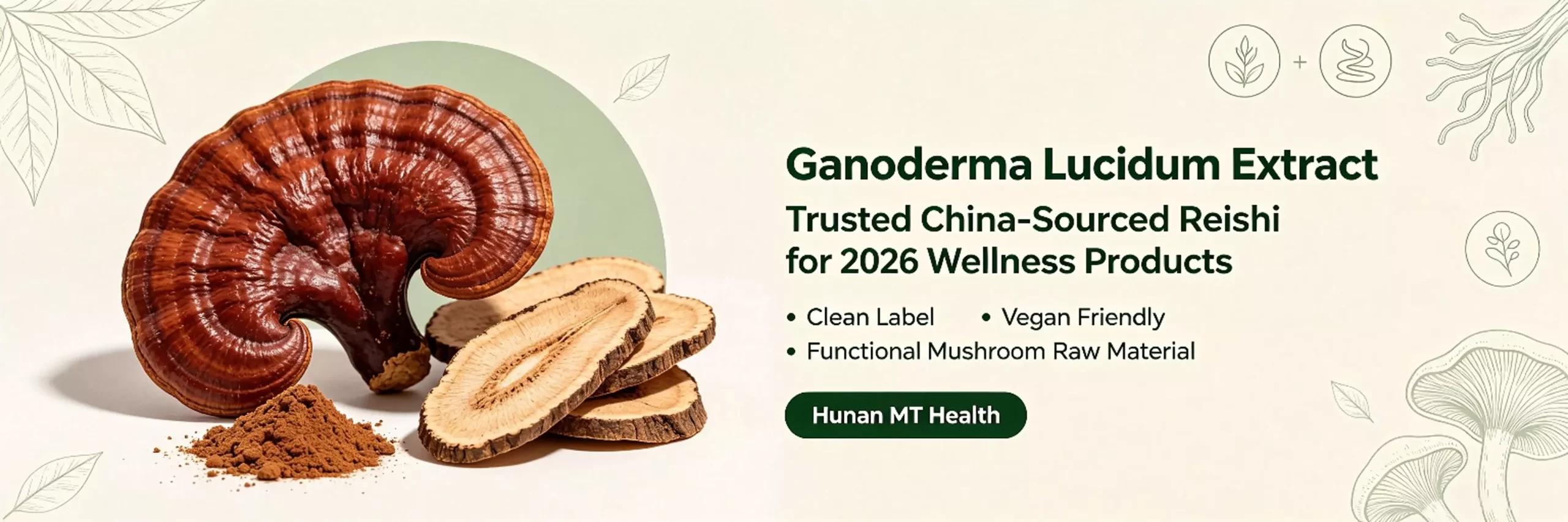
Reishi is chemically complex.
Research has identified multiple groups of constituents in Ganoderma lucidum, including:
Polysaccharides
Triterpenoids
Sterols
Proteins and peptides
Nucleosides
Other small molecules
Among these, polysaccharides and triterpenoids receive particularly strong attention in reishi research and commercial standardization.
This chemical diversity explains why extraction technology matters.
A solvent does not simply “remove the good compounds.”
Instead, the solvent creates a selective extraction environment.
Different solvents interact differently with different compounds.
That means changing the extraction method can change:
What is extracted → how concentrated it becomes → the final extract profile → how the ingredient performs in a formulation.
This is the key to understanding water versus alcohol extraction.
Water extraction is one of the most established approaches for obtaining water-soluble constituents from reishi.
In commercial and research settings, hot water extraction is particularly common for reishi polysaccharides.
The basic concept is relatively straightforward:
Reishi raw material + hot water + controlled extraction → filtration/concentration → drying → reishi extract powder
Temperature, extraction time, material-to-liquid ratio, particle size, and subsequent purification can all influence the final product.
Research reviews identify hot water extraction as a major method for preparing Ganoderma lucidum polysaccharides.
Many mushroom polysaccharides are water-soluble or can be extracted into aqueous systems under appropriate conditions.
Reishi polysaccharides are generally associated with complex structures containing glucose and other monosaccharides. Their extraction and purification are therefore strongly influenced by the extraction environment and subsequent processing.
This makes water extraction particularly attractive when polysaccharide content is an important product specification.
Alcohol extraction generally refers to the use of ethanol or an ethanol-water system to extract compounds with different polarity characteristics from the mushroom.
For reishi, ethanol-based extraction is commonly investigated for triterpenoids, including compounds within the ganoderic acid family.
Recent research reviews report ethanol-based extraction conditions for reishi triterpenoids and demonstrate that solvent concentration, temperature, time, and extraction technology can significantly affect the resulting extract.
The simplified process can be described as:
Reishi raw material + ethanol or ethanol-water system → extraction → filtration → solvent recovery → concentration → drying
In industrial food and nutraceutical manufacturing, solvent recovery and control are important parts of the process.
The easiest way to understand the two methods is to think about solubility.
| Factor | Water Extraction | Alcohol/Ethanol Extraction |
|---|---|---|
| Main solvent | Water | Ethanol or ethanol-water |
| Particularly suitable for | Polysaccharides and other water-soluble compounds | Many triterpenoids and less-polar compounds |
| Common application | Polysaccharide-focused reishi extracts | Triterpenoid-focused extracts |
| Food-processing suitability | High | Depends on process and solvent control |
| Solvent recovery | Not required for water itself | Required |
| Typical product positioning | Mushroom polysaccharide extract | Triterpenoid-rich botanical extract |
| Best choice | When water-soluble components are the target | When less-polar compounds are the target |
The important point is that neither extraction method is universally superior.
The appropriate method depends on the chemical profile the manufacturer wants to obtain.
Polysaccharides are among the most commercially important components associated with reishi.
They are also one of the areas where extraction technology can significantly influence the final ingredient.
Hot water extraction can be followed by processes such as:
Filtration
Concentration
Alcohol precipitation
Ultrafiltration
Chromatographic purification
Spray drying
Research literature describes water extraction followed by ethanol precipitation as a common approach for isolating reishi polysaccharides.
This is an important distinction:
Ethanol precipitation is not the same as ethanol extraction.
In polysaccharide processing, ethanol may be added after aqueous extraction to precipitate polysaccharides from the water extract.
This terminology can easily confuse buyers who are comparing suppliers.
When reviewing a product specification, ask the supplier to clearly explain:
Was ethanol used as the primary extraction solvent, or was ethanol used later for precipitation/purification?
That single question can provide valuable insight into the manufacturing process.
Triterpenoids have different chemical properties from polysaccharides.
Many reishi triterpenoids are less water-soluble, which makes organic solvent systems, particularly ethanol-based systems, useful for extracting them.
Research has reported ethanol extraction conditions for reishi triterpenoids and demonstrated that ethanol concentration and processing conditions can affect triterpenoid yield and composition.
This means that if a manufacturer is developing a triterpenoid-focused reishi ingredient, an ethanol-based extraction process may be more appropriate than relying solely on hot water extraction.
The final specification might focus on parameters such as:
Total triterpenoids
Specific triterpenoid compounds
Ganoderic acids
Other marker compounds
The exact analytical method and specification should be established according to the intended product.
This is a common marketing question, but it requires a more precise answer.
Water is obviously a familiar food-grade solvent and is widely used in food processing.
However, “water extracted” does not automatically mean better, more natural, or more effective.
Likewise, “ethanol extracted” does not automatically mean harsher or lower quality.
Ethanol is also widely used in food, pharmaceutical, and botanical extraction applications, provided the process is properly controlled.
The relevant questions are:
What compound is being targeted?
What solvent is appropriate for that compound?
How is the extraction controlled?
How is the solvent removed or recovered?
What is the final specification?
What testing verifies the finished ingredient?
For professional ingredient sourcing, process suitability is more meaningful than simplistic “natural vs. chemical” labels.
Can Water and Alcohol Extract Different Parts of the Reishi Profile?
Yes.
This is one of the most important concepts for understanding reishi extraction.
Imagine the mushroom as a complex mixture of compounds.
Water preferentially interacts with water-soluble constituents.
Ethanol can interact more effectively with many compounds that are less polar.
Therefore:
Water extraction can emphasize one part of the chemical profile, while ethanol extraction can emphasize another.
This does not necessarily mean one extract contains only polysaccharides and the other contains only triterpenoids.
Real extracts are more complicated.
Extraction selectivity depends on:
Solvent concentration
Temperature
Extraction time
Particle size
Material-to-solvent ratio
Number of extraction cycles
pH
Raw-material composition
Purification process
A recent review of Ganoderma lucidum specifically notes that different extraction methods affect the active-ingredient profile and summarizes approaches targeting both polysaccharides and triterpenoids.
This is where the discussion becomes more interesting for commercial product development.
A dual-extraction approach attempts to obtain compounds with different solubility characteristics from the same mushroom material.
One possible process concept is:
Ethanol extraction → recovery of alcohol-soluble constituents → hot-water extraction → recovery of water-soluble constituents
The exact sequence and manufacturing parameters vary by manufacturer.
Recent research has explored continuous or sequential extraction strategies designed to recover both triterpenoids and polysaccharides from Ganoderma lucidum.
The potential advantage is broader utilization of the raw material.
Instead of designing an extraction process around only one compound class, manufacturers can consider the wider chemical profile.
However, dual extraction should not automatically be considered superior either.
The resulting product must still be characterized analytically.
The answer depends on the type of supplement.
If the product focuses on polysaccharides:
A hot-water-extracted reishi product may be appropriate.
If the product focuses on triterpenoids:
An ethanol-based extract may be more suitable.
If the formulation aims for a broader reishi profile:
A dual-extraction or carefully designed multi-stage process may be considered.
But the ingredient label and specification should determine the decision.
For example, a buyer looking for:
“Reishi Extract 30% Polysaccharides”
should evaluate the supplier differently from a buyer looking for:
“Reishi Extract 10% Triterpenoids.”
The extraction process should support the requested specification.
For food and beverage manufacturers, the answer also depends on the formulation.
A water-based extract may be attractive when:
The product is aqueous
Polysaccharides are the primary target
Water dispersibility is important
The product is designed for functional beverages
An ethanol-derived extract may be suitable when:
Triterpenoids are the primary target
The final ingredient specification requires them
The manufacturing process can appropriately manage solvent recovery and residual-solvent requirements
For a commercial beverage, however, ingredient performance must be tested in the actual finished formulation.
Important factors include:
Dispersibility
Sedimentation
Taste
Color
Stability
pH compatibility
Heat stability
Shelf-life performance
A laboratory extraction result does not automatically predict how an extract will perform in a commercial beverage.
Not by itself.
This is an important point for B2B procurement.
Two suppliers may both offer “water-extracted reishi powder,” but the products can still differ significantly.
Quality depends on a broader system:
Raw material → extraction → purification → concentration → drying → analytical testing → packaging → storage
For reishi extracts, buyers should consider:
Raw Material
Ganoderma species
Fruiting body vs. mycelium
Growing conditions
Raw-material identity
Extraction
Water
Ethanol
Ethanol-water
Sequential extraction
Extraction temperature
Extraction time
Standardization
Polysaccharides
β-glucans where specified
Total triterpenoids
Ganoderic acids
Other marker compounds
Quality Control
Heavy metals
Pesticide residues
Microbiology
Residual solvents where applicable
Other market-specific parameters
Documentation
COA
Product specification
Traceability information
Relevant certifications
A high-quality supplier should be able to explain these parameters clearly.
Before purchasing bulk reishi extract, ask the supplier the following questions.
1. What Species Is Used?
Confirm the botanical identity.
Do not assume that every product labeled “reishi” has the same species or raw-material source.
2. Is It Fruiting Body or Mycelium?
These materials can have different compositions and should not be treated as interchangeable.
3. What Extraction Method Is Used?
Ask specifically whether the product is:
Hot-water extracted
Ethanol extracted
Ethanol-water extracted
Dual extracted
4. What Is the Standardization?
Ask for the exact specification.
For example:
Polysaccharides
β-glucans
Total triterpenoids
Ganoderic acids
5. How Is the Specification Tested?
Analytical methods should be appropriate for the stated marker compounds.
6. Can You Provide a Batch-Specific COA?
A COA helps buyers verify whether the supplied batch meets the agreed specification.
7. What Are the Storage Conditions?
Mushroom extracts should be stored according to the supplier’s product specification, particularly with respect to moisture and temperature.
There is no single winner.
Instead, use this simple framework:
Choose Water Extraction When:
You primarily want water-soluble components, particularly polysaccharides, and your application is compatible with an aqueous extraction approach.
Consider Alcohol Extraction When:
You primarily want less-polar compounds such as many reishi triterpenoids and require a triterpenoid-focused specification.
Consider Dual Extraction When:
You want to explore a broader range of reishi constituents and the product specification justifies a more complex extraction process.
The key is to start with the desired chemical profile, not the extraction method.
Why Extraction Technology Matters to Hunan MT Health Reishi Extract
At Hunan MT Health, we view mushroom extraction as a product-specification issue rather than simply a processing label.
Our mushroom ingredient portfolio includes several commercially relevant mushroom extracts, including:
Reishi Mushroom Extract
Shiitake Extract
For reishi, customers may have different requirements depending on whether the ingredient is intended for a dietary supplement, functional food, beverage, or mushroom blend.
A professional B2B discussion should therefore begin with:
From there, manufacturers can evaluate the appropriate raw material, extraction strategy, concentration, drying method, analytical testing, and final specification.
For commercial customers, Hunan MT Health can discuss:
Reishi extract specifications
Extraction method
Polysaccharide specifications
Triterpenoid specifications
Product samples
COA
Quality documentation
Packaging
MOQ
Bulk supply requirements
Is water extraction better than alcohol extraction for reishi?
Neither is universally better. Water extraction is commonly used for reishi polysaccharides, while ethanol-based extraction can be useful for extracting many triterpenoids. The appropriate method depends on the target compounds and finished-product requirements.
Does alcohol extraction remove the polysaccharides from reishi?
Polysaccharides are generally water-soluble and poorly soluble in alcohol. In many polysaccharide-production processes, alcohol is actually used after water extraction to precipitate the polysaccharides rather than as the primary extraction solvent.
What are the main compounds in reishi extract?
Reishi contains multiple compound classes, with polysaccharides and triterpenoids among the most extensively studied. It also contains sterols, proteins, peptides, nucleosides, and other constituents.
Is hot-water extraction suitable for reishi supplements?
Yes. Hot-water extraction is a well-established approach for obtaining reishi polysaccharide-rich extracts. However, the final product should be evaluated according to its actual specification and intended application.
What is dual extraction?
Dual extraction generally refers to a sequential or combined strategy designed to recover compounds with different solubility characteristics, such as ethanol-soluble triterpenoids and water-soluble polysaccharides. Research has explored sequential extraction approaches for Ganoderma lucidum.
When comparing reishi extracts, it is tempting to ask:
Which extraction method is better?
But that question is incomplete.
A more useful question is:
Which extraction method is better for the compounds, specification, and application I need?
If the goal is a polysaccharide-focused reishi extract, hot-water extraction has a clear technical rationale.
If the goal is a triterpenoid-focused extract, an ethanol-based process may be more appropriate.
If the objective is a broader chemical profile, a carefully controlled sequential or dual-extraction strategy may offer another option.
Ultimately, extraction is only one part of ingredient quality.
The strongest B2B evaluation considers:
Species → raw material → extraction method → target compounds → standardization → analytical testing → application performance → batch consistency.
That is a much more reliable way to evaluate reishi extract than simply choosing the solvent with the better-sounding marketing story.
Hunan MT Health supplies Reishi Mushroom Extract and other mushroom extracts for international B2B customers.
If you are developing a supplement, functional beverage, mushroom blend, or functional food product, contact us to discuss your target specification.
We can provide product specifications, samples, COA, technical information, packaging options, and bulk quotation based on your project requirements.
The right reishi extraction method is not the one that sounds most impressive. It is the one that produces the chemical profile, quality, and formulation performance your product actually requires.
Hunan MT Health try best to understand customer’s needs, predict the market changes, put forward innovative solutions, Adopt creative thinking and advanced technology to improve better service. You are welcome to visit our company any time!
Chat
Leave Your Message
Send your inquiry


 TH
TH  EN
EN  ZH
ZH  AR
AR  EN_GB
EN_GB  DA
DA  DE
DE  ES
ES