Sep 16, 2026
Ube has moved far beyond its traditional role as a regional purple yam ingredient. Today, its distinctive color, characteristic flavor, and versatility are attracting attention from beverage brands, bakery manufacturers, dessert companies, food developers, and ingredient buyers around the world.
But for B2B buyers, sourcing ube powder is about more than finding a purple powder at a competitive price.
The real challenge is finding an ingredient with reliable botanical identity, consistent quality, suitable processing characteristics, professional documentation, and the flexibility to fit different product formulations.
This is where the difference between a basic raw-material supplier and a solution-oriented ingredient manufacturer becomes important.
At Hunan MT Health, our Ube Powder is positioned not simply as a purple yam powder, but as part of an integrated ingredient solution covering raw material identification, processing, quality control, technical support, customization, and after-sales service.
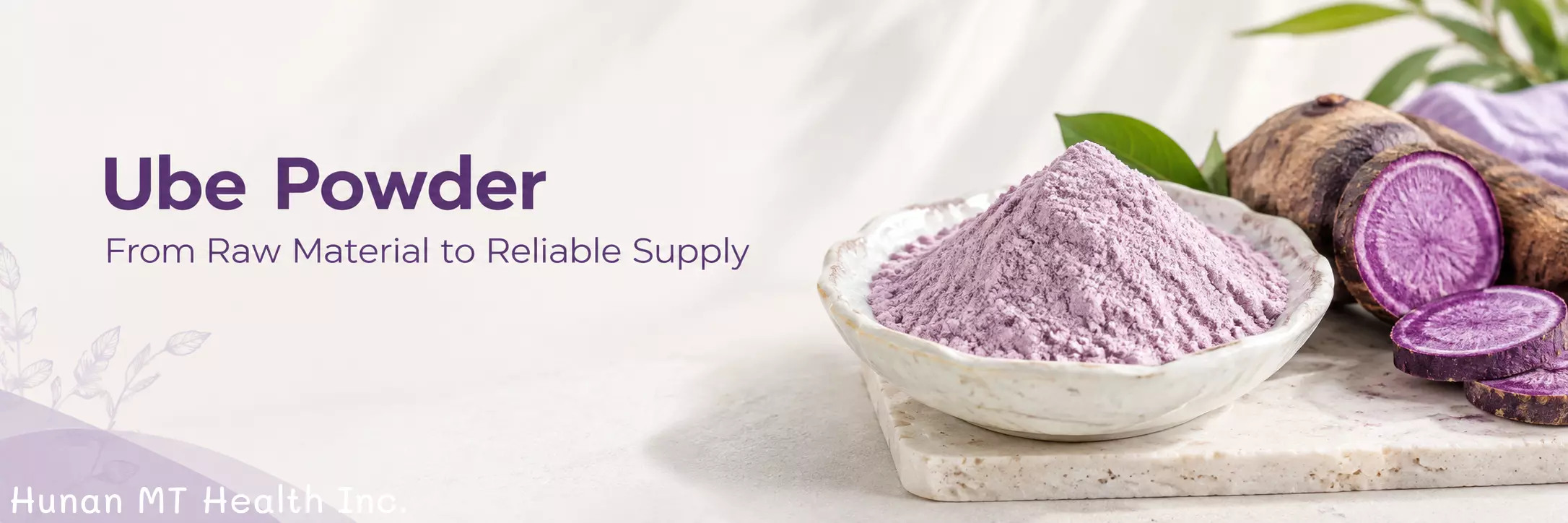
Ube is commonly associated with purple yam, botanically known as Dioscorea alata. It is different from purple sweet potato (Ipomoea batatas) and taro (Colocasia esculenta), although all three can appear in purple-colored food products.
Dioscorea alata is one of the most widely distributed yam species and has been studied for its nutritional composition, processing characteristics, and potential use in processed foods. Research has also highlighted the importance of cultivar differences and processing conditions when evaluating purple yam ingredients.
Ube is valued by food manufacturers for two particularly recognizable characteristics:
Its distinctive purple or lavender appearance
Its characteristic yam-like, mildly sweet and nutty flavor profile
These characteristics make Ube Powder interesting for applications such as beverages, bakery products, desserts, ice cream, confectionery, and other food formulations.
However, the final color and sensory profile can vary depending on the cultivar, raw material condition, processing method, and formulation. This is why professional sourcing requires more than simply comparing product names.
One of the most important questions for a B2B buyer is surprisingly basic:
What plant is actually in the bag?
The commercial market contains a variety of purple ingredients that can look similar after drying and milling. Ube, purple sweet potato, and taro are not interchangeable botanically, even though they may all be used in purple food applications.
For product developers, accurate botanical identity is therefore an important part of raw-material control.
Hunan MT Health identifies its Ube Powder as Dioscorea alata, providing a clearer basis for product development and purchasing decisions.
The company’s current quality system also includes plant identity testing through Eurofins ID, according to the product information presented by Hunan MT Health.
This approach helps shift the sourcing discussion from:
“Does the powder look purple?”
to:
“Can the raw material be identified, documented, and consistently supplied?”
That distinction matters when an ingredient is intended for commercial production rather than occasional small-batch use.
Ube powder quality does not begin at the final packaging stage.
It begins with the raw material.
Differences in cultivar, growing conditions, maturity, storage, and processing can influence the physical and chemical characteristics of yam-based ingredients. Scientific reviews have noted considerable variation among Dioscorea alata cultivars and emphasized that processing can affect anthocyanins, phenolic compounds, starch properties, and other characteristics.
For industrial buyers, this means a stable supply chain needs to consider multiple stages:
Raw Material Selection → Botanical Identification → Processing → Quality Control → Finished Product Testing → Packaging → Delivery
This is fundamentally different from simply purchasing an agricultural raw material and grinding it into powder.
A controlled manufacturing process provides more opportunities to manage consistency and match the ingredient to its intended application.
Purple yam contains significant amounts of starch, and its color is associated with naturally occurring pigments including anthocyanins in purple-fleshed cultivars. Research has shown that processing conditions can influence the retention and characteristics of these compounds. Heat, drying conditions, cultivar differences, and other processing variables can all affect the final ingredient.
For this reason, Ube Powder should be evaluated not only by its appearance but also by its processing history and intended application.
A beverage developer may have different requirements from a bakery manufacturer.
A dessert producer may focus more heavily on flavor and appearance.
A food ingredient distributor may prioritize documentation, packaging, MOQ, shelf-life information, and supply continuity.
There is no single specification that is automatically ideal for every buyer.
The better approach is to define the application first and then select the appropriate ingredient specification.
Ube has considerable potential across multiple food categories because it combines a recognizable visual identity with a distinctive flavor profile.
Ube is particularly suitable for visually distinctive beverage concepts.
Ube latte, milk tea, smoothies, shakes, and other creamy beverages can use Ube Powder to create a characteristic purple appearance and yam-inspired flavor.
For beverage developers, the important factors include dispersion behavior, flavor intensity, color performance, and compatibility with the rest of the formulation.
The objective is not simply to create a purple drink. It is to develop a beverage with a consistent sensory profile that can be reproduced from batch to batch.
Ube can also be incorporated into cakes, cookies, breads, fillings, pastries, and other bakery concepts.
Research on purple yam has explored its incorporation into different processed food products, including bakery products, noodles, beverages, and other formulations.
For bakery applications, developers need to consider how the ingredient interacts with flour, moisture, heat, fats, sugars, and other components.
This is one reason application testing is often more useful than judging a powder from its appearance alone.
Ube has a natural connection with desserts.
Potential applications include:
Ice cream
Frozen desserts
Puddings
Cake fillings
Creams
Cookies
Confectionery
Dessert sauces
Its purple visual identity can also help brands create products that are immediately recognizable on social media and retail shelves.
Ube can also be incorporated into new product concepts where color and flavor are both part of the consumer experience.
Food manufacturers may explore Ube Powder in:
Snack products
Instant beverage mixes
Dessert premixes
Bakery premixes
Plant-based formulations
Foodservice ingredients
This makes Ube Powder more than a single-category ingredient. It can become a platform for developing a family of products around one recognizable flavor concept.

One common mistake in ingredient sourcing is treating all purple powders as equivalent.
They are not.
Ube Powder, Purple Sweet Potato Powder, and Taro Powder can have different botanical identities, flavor profiles, starch characteristics, and processing behaviors.
For example, purple sweet potato is generally associated with Ipomoea batatas, while ube belongs to the genus Dioscorea. Scientific literature on purple yam also confirms that Dioscorea alata contains different varieties with substantial variation in composition and pigmentation.
Therefore, a professional product specification should clearly define:
Botanical name
Common product name
Raw material source
Processing method
Appearance
Flavor profile
Particle characteristics
Microbiological requirements
Heavy metal requirements
Relevant analytical specifications
Packaging
Shelf life
Documentation
This information gives product developers a much stronger foundation for formulation and scale-up.
Different customers rarely need exactly the same ingredient solution.
A small beverage developer may need a trial sample and technical communication.
A food manufacturer may need a stable specification for long-term production.
A distributor may require customized packaging and documentation.
A large-scale brand may need support from sample testing through trial orders and eventually mass production.
This is why customization has become an important part of ingredient sourcing.
At Hunan MT Health, customization can involve more than the powder itself.
The company’s product information highlights customization across:
Product → Formula → Grade → Packaging
The objective is to match the ingredient solution with the customer’s functional requirements and application scenario.
Instead of forcing every buyer into one standard specification, a solution-oriented supplier can evaluate the actual use case before recommending a product configuration.
A reliable B2B ingredient supplier should provide more than a specification sheet.
Food developers often need answers to practical questions:
How should the powder be incorporated?
What dosage should be tested during formulation?
How does it behave in a specific application?
What packaging format is appropriate?
What documentation is available?
Can the specification be adjusted?
Can samples be tested before a trial order?
Can the same specification be maintained during mass production?
These questions become especially important when moving from laboratory development to commercial manufacturing.
Hunan MT Health’s product information highlights technical support backed by six universities and two research institutions, together with support covering raw-material selection, identity verification, processing, and finished-product control.
For B2B customers, this type of technical connection can reduce communication gaps between purchasing, R&D, quality assurance, and production teams.
For international ingredient buyers, quality is not determined only by the appearance of the product.
Documentation is equally important.
According to the product information provided by Hunan MT Health, its quality and certification system includes:
SC
FSSC 22000
cGMP
Kosher
Halal
Organic
The exact certification or documentation required will depend on the buyer’s market, product category, and regulatory requirements.
For procurement teams, having organized documentation can make supplier qualification more efficient and support internal quality-control processes.
This is particularly important when the ingredient will be used in products sold across multiple markets.
One of the most important differences between laboratory sourcing and commercial sourcing is continuity.
A sample may perform well in a formulation, but the real test begins when the customer places a larger order.
A practical B2B supply process should therefore support multiple stages:
Sample → Trial Order → Mass Production
Each stage answers a different question.
Sample:
Does the ingredient work in the formulation?
Trial Order:
Can the ingredient perform consistently under a more realistic production process?
Mass Production:
Can the supplier provide stable quality, documentation, packaging, and delivery over time?
This staged approach allows both the buyer and supplier to evaluate the ingredient before moving into larger-scale procurement.
Before selecting an Ube Powder supplier, B2B buyers should consider at least six questions:
1. Is the botanical identity clearly defined?
Look for the scientific name rather than relying only on terms such as “purple powder” or “purple yam.”
2. Can the supplier provide quality documentation?
Ask about COA, microbiological specifications, heavy metals, pesticide requirements, and other relevant testing.
3. Is the raw material traceable?
Understand where the raw material comes from and how identity is controlled.
4. Can the supplier provide samples?
Sample testing allows R&D teams to evaluate flavor, color, texture, processing performance, and formulation compatibility.
5. Can the product be customized?
Depending on the application, customization may involve specification, formulation, packaging, or supply arrangements.
6. Can the supplier support scale-up?
A supplier should be able to communicate effectively from initial sampling through trial orders and commercial production.
These questions help buyers evaluate the whole supply solution, rather than comparing price alone.
The development of modern food products increasingly depends on ingredients that can provide several functions at once.
Ube is interesting because it can contribute both flavor identity and visual differentiation.
At the same time, purple yam is a technically complex agricultural ingredient whose composition can vary with cultivar and processing. Scientific literature continues to identify opportunities for its use in beverages, bakery products, starch-based foods, and other commercial applications while also emphasizing the importance of processing and standardization.
For food manufacturers, this creates an opportunity—but also a sourcing responsibility.
The right supplier is not simply the company offering a purple powder.
It is the supplier that can connect:
Reliable Raw Material + Botanical Identity + Quality Control + Technical Support + Flexible Customization + International Documentation
into one workable supply chain.
At Hunan MT Health, we view Ube Powder as more than a single ingredient.
Our approach combines raw-material identification, manufacturing control, quality management, technical support, customized solutions, and long-term customer service.
Our Ube Powder is identified as Dioscorea alata, with plant identity testing through Eurofins ID as presented in our product information. We also provide support across sampling, trial orders, customization, documentation, and commercial supply.
Whether you are developing an Ube Latte, milk tea, bakery product, dessert, ice cream, confectionery, or another food application, our team can work with you to evaluate the appropriate ingredient solution.
The goal is straightforward:
Not just supplying Ube Powder, but helping customers build a reliable ingredient solution from raw material to finished product.
Hunan MT Health hace todo lo posible para comprender las necesidades del cliente, predecir los cambios del mercado, proponer soluciones innovadoras, adoptar el pensamiento creativo y la tecnología avanzada para mejorar un mejor servicio. Le invitamos a visitar nuestra empresa en cualquier momento.
Chat
Deje su mensaje
Envíe su consulta


 ES
ES  EN
EN  ZH
ZH  AR
AR  TH
TH  EN_GB
EN_GB  DA
DA  DE
DE