Sep 10, 2026
Purple is no longer just a color on the food shelf. It is becoming a product-development strategy.
From taro milk tea and purple lattes to ube desserts, purple sweet potato snacks, smoothies, ice cream, bakery products, and colorful functional beverages, purple ingredients are gaining attention across the global food and beverage industry.
The appeal is easy to understand: purple products stand out immediately, create strong visual recognition, and often connect modern product innovation with familiar Asian ingredients.
Among these ingredients, taro has played an important role in bringing purple beverages into the mainstream, particularly through the global popularity of bubble tea. At the same time, ube and purple sweet potato are creating new opportunities for brands looking for distinctive colors, flavors, and plant-based ingredients.
So, why are purple foods trending—and where does taro fit into this movement?
Food trends are increasingly driven by more than taste alone. Consumers also notice color, texture, cultural identity, ingredient stories, and how easily a product can be shared visually online.
Purple performs particularly well in this environment.
The 2025 National Restaurant Association’s National Restaurant Show highlighted purple foods and beverages as a noticeable visual trend, including products featuring blackberry, blueberry, grape, elderberry, hibiscus, black cherry, and other naturally colorful ingredients.
Meanwhile, food industry trend research for 2026 continues to identify purple as an important direction for food and beverage innovation. FoodNavigator’s 2026 color trend report specifically pointed to purple foods and beverages attracting consumer attention in Europe.
This matters to product developers because color can help a product communicate its identity before the consumer even tastes it.
A purple latte looks different from a conventional latte.
A purple ice cream immediately creates curiosity.
A purple smoothie can become a visual signature for a café.
And a purple bakery product can stand out in an increasingly crowded display.
This is one reason purple ingredients have moved beyond novelty products and into mainstream product development.
Taro has an advantage that many emerging food trends do not: it already has a strong consumption history.
Taro, botanically known as Colocasia esculenta, has long been used in Asian cuisines. It has also become closely associated with bubble tea and other modern beverages.
For many international consumers, taro milk tea was one of their first experiences with a purple-colored beverage.
That makes taro more than a temporary social-media trend.
Its flavor is generally mild, starchy, creamy, and slightly nutty, which makes it relatively easy to combine with milk, plant-based beverages, tea, coffee, sweeteners, and dessert flavors.
This versatility is particularly valuable for beverage developers.
Taro can be used in:
Taro milk tea
Taro bubble tea
Taro latte
Taro milkshakes
Taro smoothies
Taro ice cream
Taro cakes
Taro pastries
Taro puddings
Taro dessert sauces
Instant beverage mixes
Recent beverage trend research also identifies taro as an ingredient expanding beyond its traditional bubble-tea association into broader global beverage innovation.
One important point is often overlooked: taro should not be defined simply as a natural purple coloring ingredient.
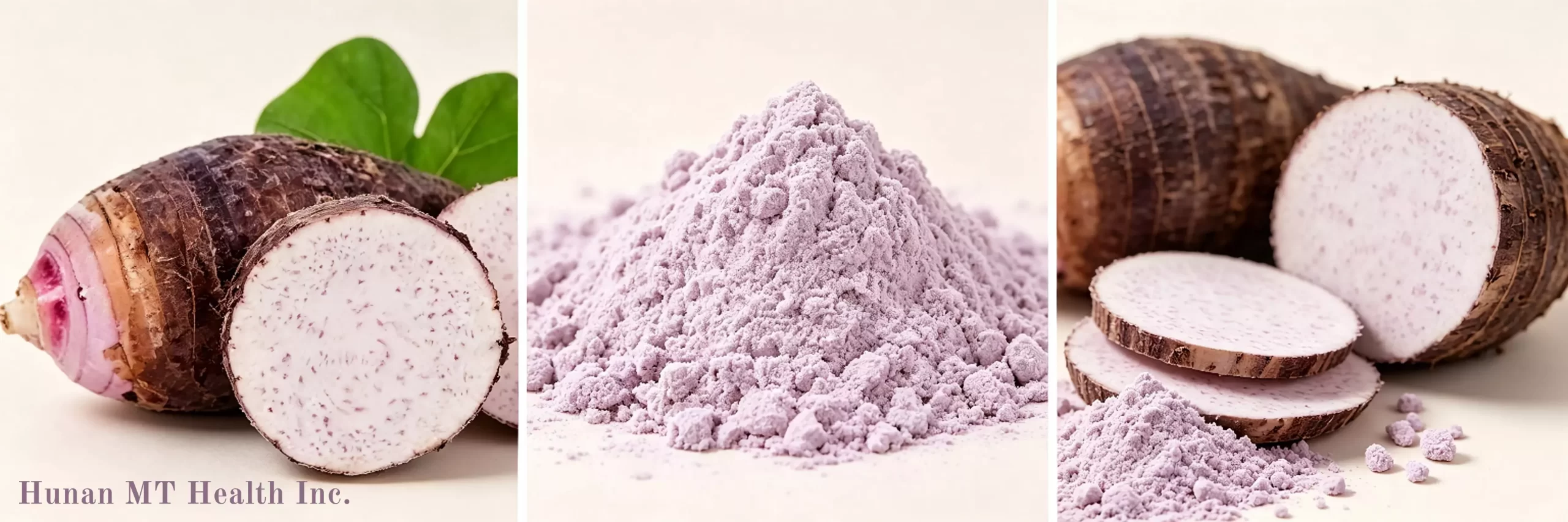
The color of taro itself can vary considerably depending on cultivar, processing, and formulation. Some taro varieties are predominantly white or cream-colored with purple or lavender fibers and speckles.
The familiar pastel-purple appearance of commercial taro beverages can therefore result from the raw material, processing, formulation, and other ingredients used in the final product.
This distinction is important for food manufacturers.
A product developer should evaluate flavor, color, texture, dispersion, processing conditions, and final appearance rather than assuming that every taro ingredient will create the same shade of purple.
That is also why ingredient specifications matter.
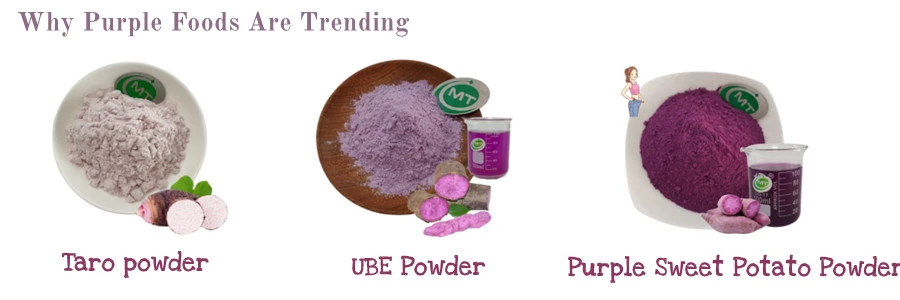
Taro vs. Ube vs. Purple Sweet Potato: What’s the Difference?
Although these three ingredients are frequently grouped together because of their colors and applications, they are not the same ingredient.
Understanding the difference can help brands choose the right raw material for a new product.
| Ingredient | Botanical identity | identityTypical profile | Common applications |
| Taro | Colocasia esculenta | Mild, creamy, starchy, slightly nutty | Bubble tea, beverages, desserts, bakery |
| Ube | Dioscorea alata | Sweet, nutty, earthy, often vanilla-like | Lattes, ice cream, bakery, desserts |
| Purple Sweet Potato | Ipomoea batatas | Sweet, earthy, potato-like | Beverages, bakery, snacks, natural color applications |
The distinction becomes increasingly important as purple ingredients move into commercial product development.
If taro helped normalize purple beverages, ube is helping push purple foods into a new global trend cycle.
Ube, or Dioscorea alata, is a purple yam strongly associated with Filipino cuisine. Traditionally used in products such as ube halaya, cakes, ice cream, and other desserts, it has recently gained much wider international exposure.
In 2026, food industry publications have highlighted the rapid expansion of ube into cafés, beverages, bakery products, and desserts.
BeverageDaily described ube as a major 2026 innovation trend, noting its expansion into coffee-shop beverages in Europe and its growing international visibility.
FoodNavigator similarly reported that ube’s distinctive purple appearance and approachable flavor are helping it gain popularity in beverages and food products.
The trend has also reached major international café markets. Starbucks and Costa have introduced ube-based beverages in European and UK markets, demonstrating how a traditionally regional ingredient can become part of mainstream product innovation.
Ube combines several characteristics that modern food developers are looking for:
1. Distinctive appearance
Its purple color creates immediate visual differentiation.
2. A recognizable flavor identity
Ube is commonly described as mildly sweet, nutty, earthy, and sometimes vanilla-like.
3. Beverage versatility
Ube can be incorporated into lattes, milk drinks, smoothies, frappes, and specialty beverages.
4. Dessert compatibility
It works naturally in ice cream, cakes, cookies, waffles, cheesecake, donuts, and other bakery applications.
5. Cultural storytelling
Ube has a genuine culinary history rather than being a color invented specifically for a marketing campaign.
This combination makes ube particularly interesting for brands looking to develop products that are both visually distinctive and culturally meaningful.
At Hunan MT Health, Ube Powder is one of the products we focus on for applications such as beverages, bakery products, desserts, and other food innovations.
Purple sweet potato offers another route into the growing purple-food category.
Unlike ube, purple sweet potato belongs to the species Ipomoea batatas. Its purple color is associated with anthocyanins, including cyanidin- and peonidin-based compounds.
Research has characterized purple sweet potato anthocyanins and demonstrated that their color behavior can change depending on pH and processing conditions.
This is particularly relevant to food manufacturers.
Natural color does not always behave like synthetic color.
Purple sweet potato anthocyanins can show different shades under different pH conditions, and temperature can influence their stability. Research published in 2024 found that purple sweet potato anthocyanin color stability was affected by both pH and temperature, with degradation becoming more pronounced under certain conditions.
Therefore, when developing a beverage or food product with purple sweet potato, manufacturers should consider:
Product pH
Processing temperature
Heating time
Storage conditions
Light exposure
Ingredient interactions
Desired final color
Raw-material specifications
This is where technical ingredient selection becomes more important than simply choosing an ingredient because it is “purple.”
Purple sweet potato powder can be considered for a wide range of applications, including:
Smoothies
Plant-based beverages
Bakery products
Cakes
Cookies
Ice cream
Dessert mixes
Snack products
Instant food mixes
Purple-colored beverage concepts
Research has also demonstrated the potential of purple sweet potato anthocyanins as food-coloring materials, while emphasizing the importance of controlling stability during processing.
At Hunan MT Health, Purple Sweet Potato Powder is another key product in our portfolio, giving food and beverage manufacturers an additional option for developing purple-colored and plant-based products.
The success of purple beverages is not based on one factor.
It is the combination of visual identity + familiar formats + new flavors + social-media appeal + ingredient storytelling.
Consider the difference between these two product concepts:
Vanilla milkshake
and
Purple Ube Vanilla Latte
The second product communicates more information before the first sip.
It has a recognizable beverage format, but the color and ingredient name create curiosity.
The same principle applies to:
Taro Bubble Tea
Ube Coconut Latte
Purple Sweet Potato Smoothie
Ube Ice Cream
Purple Sweet Potato Cake
The base category is familiar. The ingredient makes it feel new.
This is a powerful strategy for product developers because consumers do not necessarily want completely unfamiliar products. They often want familiar formats with a new sensory experience.
For B2B food manufacturers, the purple trend is more interesting when viewed as a platform rather than a single product trend.
Taro, ube, and purple sweet potato can serve different product-development objectives.
Taro: Familiarity and Beverage Culture
Taro is particularly suitable for brands targeting bubble tea, milk-based beverages, dessert drinks, and café-style products.
Its biggest advantage is consumer familiarity within the global bubble-tea ecosystem.
Ube: Novelty and Premium Visual Identity
Ube is especially attractive for brands developing premium or trend-driven beverages and desserts.
Its Filipino culinary identity and distinctive purple appearance provide both a flavor story and a visual story.
Purple Sweet Potato: Ingredient Functionality and Color Potential
Purple sweet potato can provide a different proposition, particularly when manufacturers are exploring naturally derived color components and plant-based food formulations.
The three ingredients therefore do not need to compete directly.
They can occupy different positions within the same purple-food category.
For commercial applications, color alone should never be the only purchasing criterion.
B2B buyers should evaluate several parameters before selecting an ingredient.
1. Botanical identity
Confirm exactly what the ingredient is.
Taro, ube, and purple sweet potato are botanically different materials and should not be treated as interchangeable.
2. Processing method
Ask how the raw material is processed and whether the processing method fits the intended application.
3. Color consistency
For commercial food production, batch-to-batch consistency can be critical.
4. Flavor profile
The ingredient should contribute the desired flavor without creating unwanted sensory notes.
5. Solubility and dispersion
For beverages, powder dispersion and processing behavior can strongly influence the finished product.
6. Stability
If color is an important selling point, manufacturers should test the ingredient under actual formulation conditions rather than relying only on laboratory specifications.
7. Documentation
COA, microbiological testing, heavy-metal testing, pesticide requirements, allergen information, certifications, and other technical documents should be reviewed according to the destination market and application.
This is especially important as purple ingredients move from small-batch café products into larger-scale commercial food manufacturing.
Probably not in the sense of replacing every other color.
The more useful question is whether purple can become a long-term product-development platform.
The evidence suggests that it has potential.
Taro has already established purple beverages within the global bubble-tea culture. Ube is now expanding rapidly into international cafés and desserts. Purple sweet potato provides another plant-based ingredient with anthocyanin-rich raw material and color-development potential.
At the same time, broader food trends are moving toward ingredients that combine visual differentiation with recognizable botanical or culinary origins.
That gives purple foods an advantage that purely artificial novelty colors may not have: they can tell a story.
At Hunan MT Health, we see purple ingredients not simply as a passing color trend, but as an opportunity for practical food and beverage innovation.
Our product portfolio includes Purple Sweet Potato Powder and Ube Powder, which can be considered for different applications ranging from beverages and bakery products to desserts and specialty food formulations.
For B2B buyers, the goal is not simply to find a purple powder.
The right ingredient should match the target product’s flavor profile, color expectations, processing conditions, application, specifications, packaging requirements, and supply needs.
Whether you are developing a new ube latte, a purple sweet potato beverage, a bakery product, an ice cream concept, or another visually distinctive food product, ingredient selection should begin with the final application in mind.
The rise of purple foods reflects a broader change in food innovation.
Consumers increasingly discover products through visual content, but visual appeal alone is not enough to create a sustainable category. Ingredients need recognizable flavors, cultural stories, application flexibility, and reliable performance.
Taro has helped make purple beverages familiar.
Ube is now pushing purple into a new generation of global café and dessert trends.
Purple sweet potato adds another route for manufacturers interested in plant-based ingredients and anthocyanin-rich raw materials.
Together, they show why purple is becoming more than a color.
It is becoming a language of food innovation.
For food and beverage brands, the opportunity is not simply to make another purple product. It is to understand which purple ingredient delivers the right combination of flavor, appearance, application performance, and market positioning.
And that is where the next generation of purple food products will be created.
Is taro the same as ube?
No. Taro is Colocasia esculenta, while ube is Dioscorea alata. They have different botanical identities, flavor profiles, and traditional culinary uses.
Is purple sweet potato the same as ube?
No. Purple sweet potato belongs to Ipomoea batatas, while ube is a species of yam, Dioscorea alata. Although both can provide purple-colored food products, they are different ingredients.
Why are purple foods becoming popular?
Their popularity is driven by several factors, including strong visual appeal, social-media visibility, Asian-inspired food trends, consumer interest in recognizable plant ingredients, and the versatility of purple ingredients in beverages and desserts.
What can ube powder be used for?
Ube powder can be explored for lattes, milk tea, smoothies, ice cream, cakes, cookies, waffles, donuts, dessert mixes, and other food and beverage applications.
What can purple sweet potato powder be used for?
Purple sweet potato powder can be used in smoothies, beverages, bakery products, desserts, snack products, instant mixes, and other food formulations where its characteristic flavor and color are desirable.
Can purple sweet potato provide natural color?
Purple sweet potato contains anthocyanins that contribute to its characteristic purple coloration. However, anthocyanin color can be affected by factors such as pH, temperature, and processing conditions, so application testing is important.
Is purple the next major food trend?
Purple is already appearing across beverages, desserts, bakery products, and foodservice. Ube’s rapid international expansion and the continued popularity of taro-based beverages suggest that purple ingredients have significant potential for continued product innovation.
Hunan MT Health hace todo lo posible para comprender las necesidades del cliente, predecir los cambios del mercado, proponer soluciones innovadoras, adoptar el pensamiento creativo y la tecnología avanzada para mejorar un mejor servicio. Le invitamos a visitar nuestra empresa en cualquier momento.
Chat
Deje su mensaje
Envíe su consulta


 ES
ES  EN
EN  ZH
ZH  AR
AR  TH
TH  EN_GB
EN_GB  DA
DA  DE
DE