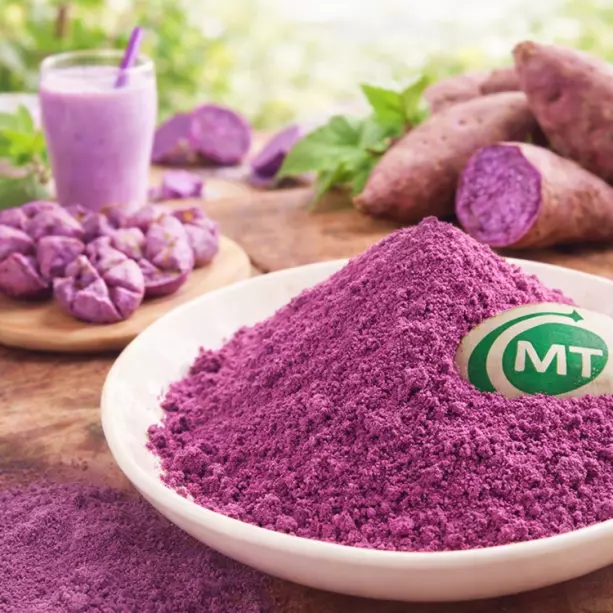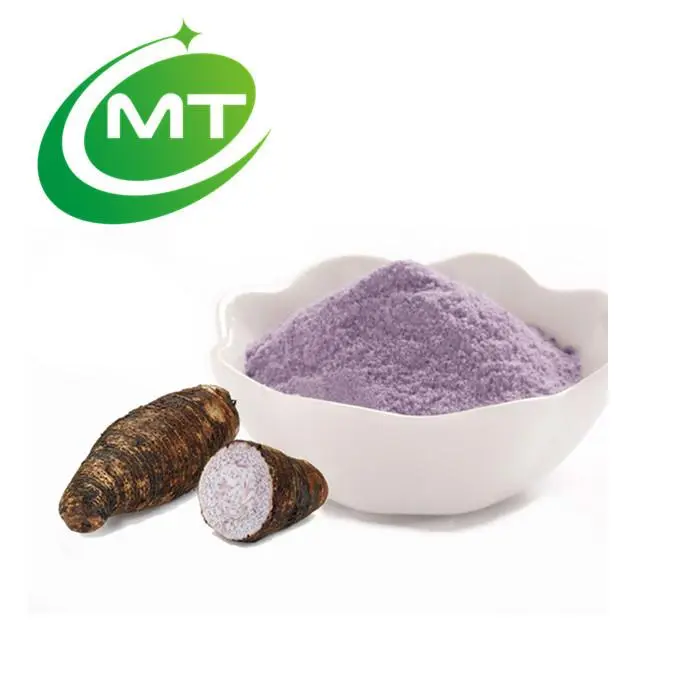


Taro Powder
Colocasia esculenta
Tuber
Powder
Light purple powder
From Asian-inspired beverages to colorful desserts and bakery products, Taro Powder is becoming an increasingly interesting ingredient for food manufacturers looking to create products with a distinctive flavor and familiar plant-based identity.
Made from taro (Colocasia esculenta), Taro Powder provides a convenient powdered form of a traditional root crop. Its characteristic mild, creamy, earthy flavor makes it suitable for both sweet and savory formulations, while its naturally starch-rich composition can contribute body and texture to selected food systems.
For B2B manufacturers, the appeal of Taro Powder goes beyond its flavor. It offers a practical way to introduce a recognizable taro concept into instant beverages, milk tea, bakery products, desserts, ice cream, snack foods, and powdered food mixes.
Hunan MT Health supplies Taro Powder for international food and beverage manufacturers, ingredient distributors, and product developers seeking consistent plant-based raw materials and reliable bulk supply.
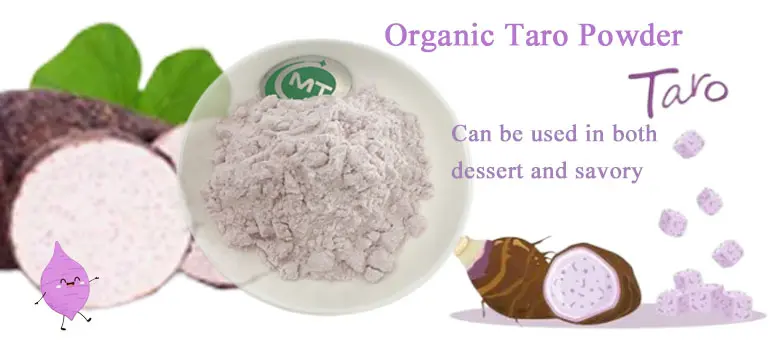
Taro is an ancient food crop with a long history of cultivation and consumption in Asia, the Pacific Islands, Africa, and other tropical and subtropical regions.
The edible corm of Colocasia esculenta is naturally rich in starch and contains dietary fiber and various minerals and plant compounds. The nutritional composition varies according to cultivar, cultivation conditions, maturity, and processing method.
When processed into powder, taro becomes much easier to incorporate into commercial formulations.
Instead of processing fresh taro during production, manufacturers can work with a dry ingredient that can be:
This makes Taro Powder particularly useful for modern food manufacturing.
Food trends increasingly move across borders.
Ingredients that were once strongly associated with regional cuisines can become global product concepts through cafés, restaurants, social media, and packaged food innovation.
Taro is a good example.
Today, consumers in different markets can encounter taro in products such as:
Taro milk tea → Taro latte → Taro ice cream → Taro cake → Taro cookies → Taro smoothie
This creates an opportunity for manufacturers to develop products around a flavor that is familiar in some markets but still relatively distinctive in others.
For B2B product developers, that distinction can be commercially valuable.
Product Specification:
| Items | Specifications | Test Methods |
| Product name | Taro Powder | / |
| Moisture Content
Ash Content Heavy Metals Arsenic (As) Cadmium (Cd) Mercury (Hg) Lead (Pb) |
NMT 5.0%
NMT 5.0% NMT 10ppm NMT 1ppm NMT 1ppm NMT 0.1ppm NMT 3ppm |
5g / 105℃ / 2hrs
2g / 525℃ / 3hrs Atomic Absorption Atomic Absorption Atomic Absorption Atomic Absorption Atomic Absorption |
| Shelf | 2 years | |
| Statements:
We hereby confirm that the product meets Kosher & Halal standard; We hereby confirm that the product is GMO free, Allergen free, Irradiation free; |
||
This is one of the most common questions from international consumers and food manufacturers.
Although Taro and Ube can both appear in purple desserts and beverages, they are different crops.
Botanical name: Colocasia esculenta
Botanical name: Dioscorea alata
Their flavors are also different.
Taro is generally associated with a mild, creamy, earthy flavor, while ube is typically characterized by a sweeter, more distinctive nutty profile.
For manufacturers, choosing between them should depend on the desired flavor identity, raw material specification, and finished product concept.
One of the strongest commercial applications for Taro Powder is beverages.
Taro milk tea has become one of the most recognizable taro-based beverage concepts.
Taro Powder can be incorporated into milk tea formulations to provide:
Depending on the formulation, it may be combined with milk powder, plant-based milk ingredients, tea extracts, sweeteners, and other flavor ingredients.
Taro latte provides an opportunity for cafés and beverage brands to position taro outside traditional milk tea.
Potential concepts include:
This creates opportunities for both foodservice and instant beverage manufacturers.
Taro Powder can be incorporated into smoothie and shake formulations with:
Its creamy sensory profile can complement fruit-based formulations.
Taro is particularly compatible with products where flavor and visual presentation are important.
Taro Powder can be used in:
Potential applications include:
Manufacturers can also explore:
The appropriate dosage depends on the desired flavor intensity and the characteristics of the finished formulation.
Taro powder is an excellent source of dietary fiber, promoting healthy digestion and preventing bloating.
The potassium in taro helps regulate blood pressure, while its antioxidants reduce oxidative stress on the cardiovascular system.
With high levels of vitamin C and E, taro powder strengthens the immune system and protects against infections.
Unlike processed sugars, taro powder provides slow-releasing carbohydrates, keeping you energized throughout the day.
Perfect for those with dietary restrictions, taro powder is a great addition to gluten-free and plant-based recipes.
Taro's international potential comes from its ability to connect traditional food culture with modern product formats.
A manufacturer can take the same core ingredient and develop different products for different markets:
Taro milk tea, desserts, pastries, and traditional-inspired foods.
Taro lattes, ice cream, smoothies, protein products, and bakery items.
Plant-based desserts, specialty beverages, bakery products, and innovative snack concepts.
Desserts, beverage powders, ice cream, and bakery applications.
The formulation should always be adapted to local consumer preferences and food regulations.
For international B2B customers, reliable ingredient supply is just as important as product quality.
Hunan MT Health focuses on supplying plant-based food ingredients for manufacturers and distributors worldwide.
Our Taro Powder solutions are designed around key B2B requirements such as:
We focus on controlling important characteristics such as appearance, flavor, moisture, and powder properties according to the agreed specification.
Quality management may include testing of:
We can discuss product requirements based on:
We support customers including:
Taro Powder is more than a trending beverage ingredient.
Its combination of distinctive flavor, plant-based identity, starch-rich composition, and broad application potential gives manufacturers multiple ways to create new products.
Whether your goal is to launch a:
Taro Milk Tea
Taro Latte
Taro Ice Cream
Taro Cake
Taro Smoothie
or another innovative food product, choosing the right raw material is the first step toward a consistent final product.
At Hunan MT Health, we help B2B customers source Taro Powder for product development and commercial manufacturing.
Request a sample, COA, technical specification, or bulk quotation today.
Let us discuss your application and help you select a Taro Powder solution that fits your production requirements.
Taro Powder is made from the edible corm of Colocasia esculenta. The raw material is processed and dried before being milled into powder.
Taro typically has a mild, creamy, earthy, and slightly nutty flavor with subtle sweetness.
No. Taro is Colocasia esculenta, while Ube is purple yam, Dioscorea alata. They have different botanical origins and sensory profiles.
Common applications include milk tea, bubble tea, lattes, smoothies, ice cream, cakes, cookies, pastries, confectionery, and other food products.
Not necessarily. The color depends on the taro variety and processing method. Some products may be cream, off-white, grayish, or light purple.
Yes. Taro is naturally a starch-rich root crop. The exact starch content depends on the raw material and processing method.
Yes. Taro Powder can be incorporated into powdered beverage formulations, although its dispersion and sensory performance should be evaluated in the specific beverage system.
Yes. B2B customers can contact Hunan MT Health to discuss samples, product specifications, COA, packaging, and bulk purchasing requirements.
Hunan MT Health hace todo lo posible para comprender las necesidades del cliente, predecir los cambios del mercado, proponer soluciones innovadoras, adoptar el pensamiento creativo y la tecnología avanzada para mejorar un mejor servicio. Le invitamos a visitar nuestra empresa en cualquier momento.
Chat
Deje su mensaje
Envíe su consulta


 ES
ES  EN
EN  ZH
ZH  AR
AR  TH
TH  EN_GB
EN_GB  DA
DA  DE
DE