Oct 22, 2026
Choosing a sweetener for a dietary supplement is not just about making a formula taste sweet. It also affects ingredient labeling, serving size, powder volume, mouthfeel, manufacturing efficiency, and the overall consumer experience.
Two ingredients often considered in reduced-sugar formulations are Stevia Powder and Erythritol. Both can help manufacturers reduce reliance on conventional sugar, but they perform very different functions.
Stevia-derived sweeteners are high-intensity sweeteners that provide sweetness at low inclusion levels. Erythritol is a sugar alcohol that provides more physical bulk and a sweetness level closer to sugar. The right choice depends on whether your product needs intense sweetness, formulation volume, a particular mouthfeel, or a combination of these properties.
For supplement brands developing drink powders, gummies, chewable tablets, flavored protein blends, or powdered nutrition products, understanding this difference can help prevent costly formulation adjustments.
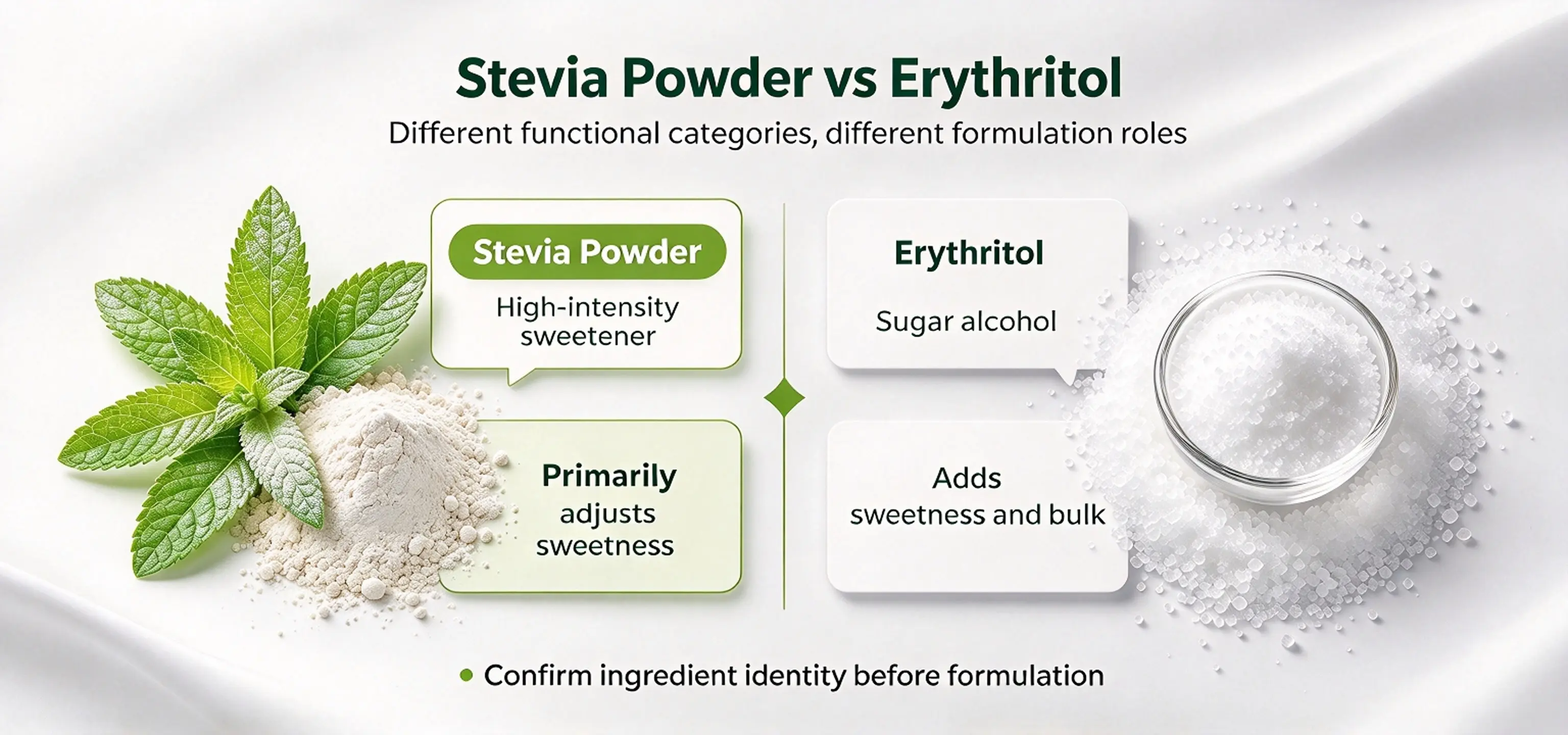
Although both ingredients are used in sugar-reduction strategies, they belong to different functional categories.
Stevia Powder is a broad commercial term. Depending on the supplier, it may refer to stevia leaf powder, a stevia extract, or a powder containing purified steviol glycosides. These forms should not be treated as interchangeable because their composition, sweetness intensity, flavor profile, and regulatory status can differ.
Purified steviol glycosides, the compounds responsible for stevia’s sweetness, are reported by the U.S. FDA to be approximately 200–400 times sweeter than sucrose.
Erythritol is a sugar alcohol, also called a polyol. It is generally less sweet than sugar and can contribute solids and bulk to a formulation. Its physical presence makes it useful when a formulator needs more than sweetness alone.
The practical distinction is straightforward: stevia-derived sweeteners primarily adjust sweetness, while erythritol can contribute both sweetness and formulation volume.
Stevia-derived sweeteners are particularly relevant when a supplement brand wants to achieve a desired sweetness level without adding large quantities of a sweetening ingredient.
High sweetness intensity
Because purified steviol glycosides are much sweeter than sucrose, relatively small quantities can deliver the desired sweetness. This can be useful when the formula has limited space for additional ingredients.
Formulation flexibility
Stevia can be considered for flavored powders, drink mixes, selected chewable formats, and other products where a concentrated sweetening ingredient is appropriate. Its suitability depends on the specific stevia material, the formulation, and the intended market.
Flavor optimization still matters
High sweetness intensity does not automatically produce a sugar-like taste. Depending on the steviol glycoside profile and use level, some stevia preparations may have bitter, herbal, or licorice-like aftertastes.
Product developers should therefore assess sweetness onset, lingering sweetness, flavor masking, and compatibility with the product’s other ingredients.
A critical sourcing distinction
When purchasing Stevia Powder, confirm whether the product is leaf powder, crude extract, or a specified steviol glycoside preparation. These materials have different properties and cannot be assumed to share the same food-use status. The FDA’s conclusions for certain highly purified steviol glycosides do not automatically apply to whole stevia leaves or crude extracts.
For supplement manufacturers, an accurate product specification is the starting point for both formulation and compliance review.
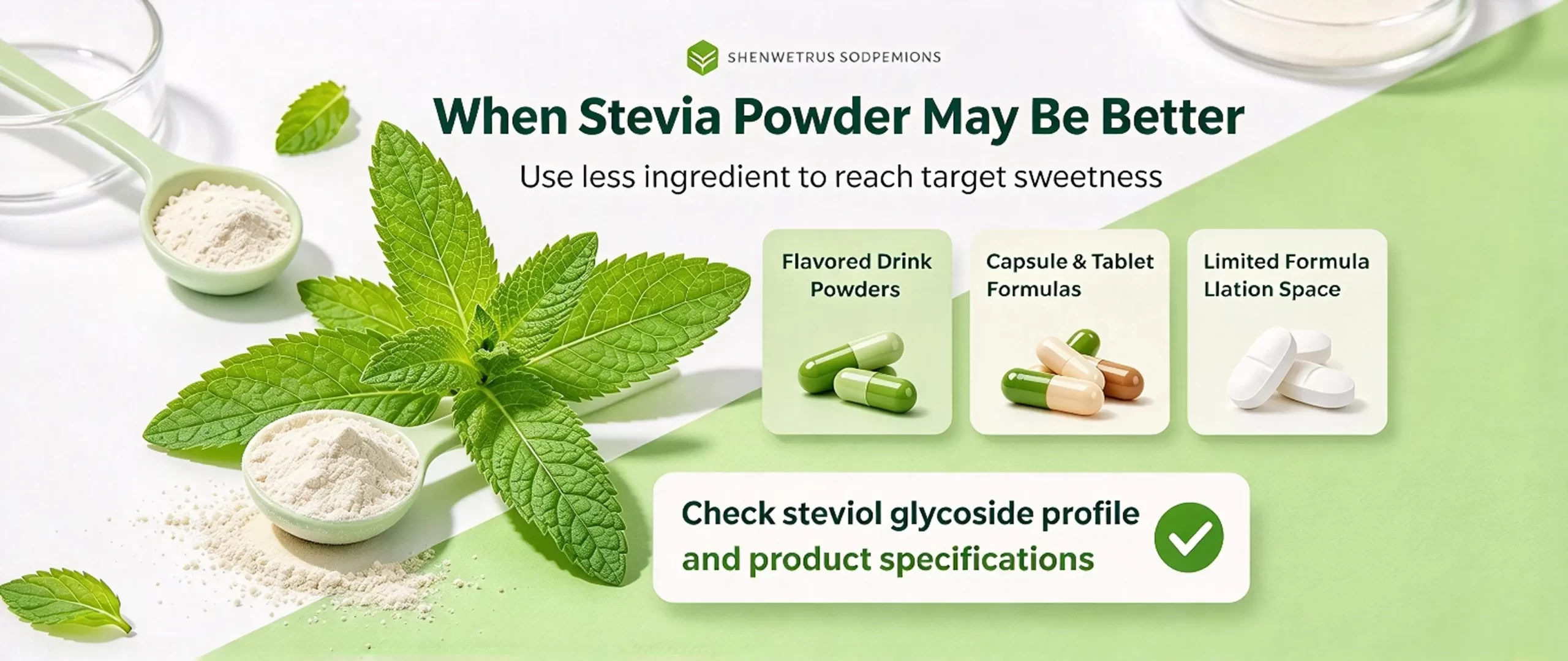
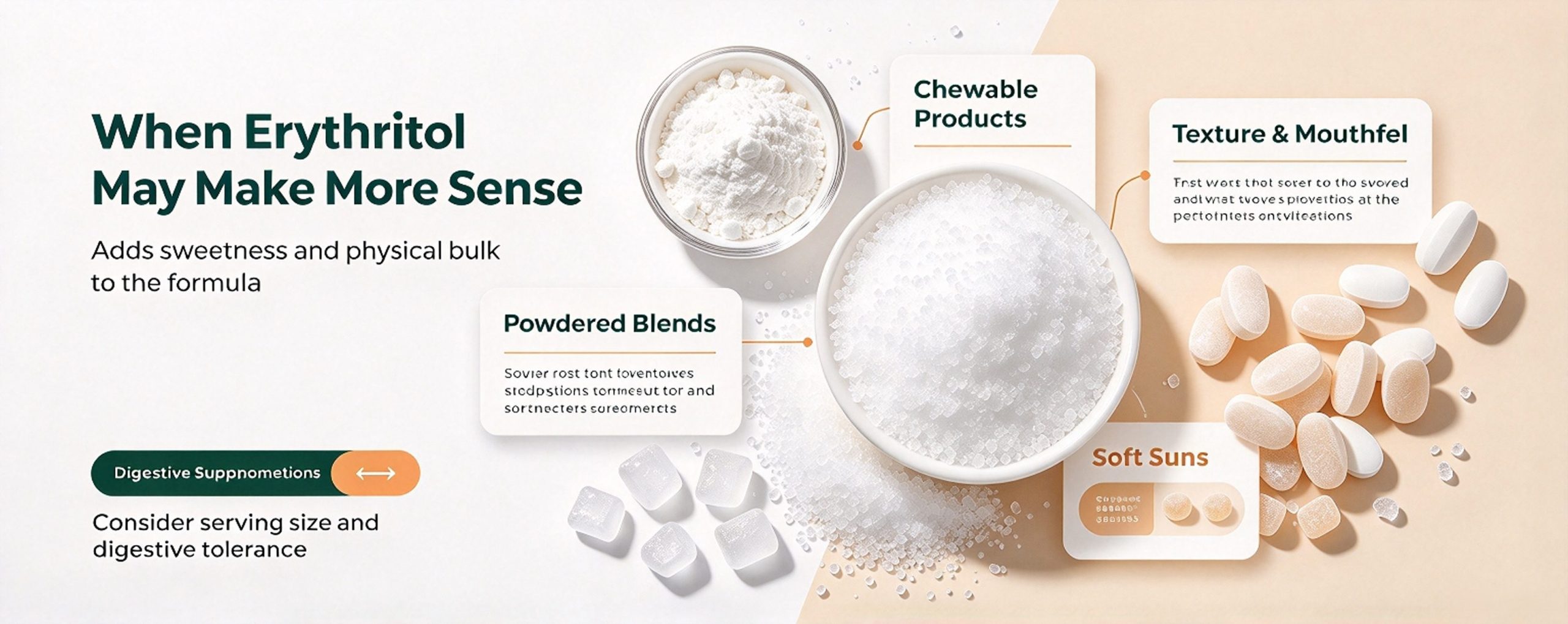
Erythritol may be a better fit when the formula needs a sweetening ingredient that also contributes bulk.
Adds physical solids
Unlike high-intensity stevia sweeteners, erythritol can occupy a meaningful portion of a formula. This can help when developing powdered blends or chewable products that require a particular weight, texture, or mouthfeel.
However, erythritol should not automatically be treated as a complete replacement for sugar. Its physical and sensory properties differ from sucrose, and the final formula may need other ingredients to achieve the desired performance.
Provides a mild sweetness profile
Erythritol’s sweetness is closer to that of sugar than the concentrated sweetness of purified steviol glycosides. This can make it useful in formulations where a larger amount of sweetening material is needed.
It also has a characteristic cooling sensation in the mouth. Depending on the flavor system and inclusion level, this may be desirable in some products but less suitable in others.
Consider digestive tolerance
Erythritol is generally well tolerated at commonly used levels, but tolerance varies by individual and intake. As with other sugar alcohols, product developers should consider serving size and the amount consumed across multiple servings.
Understand its role in the formula
Erythritol is useful when sweetness and physical structure both matter. However, it may not be the most efficient choice if the only goal is to provide sweetness while minimizing the amount of sweetener added.
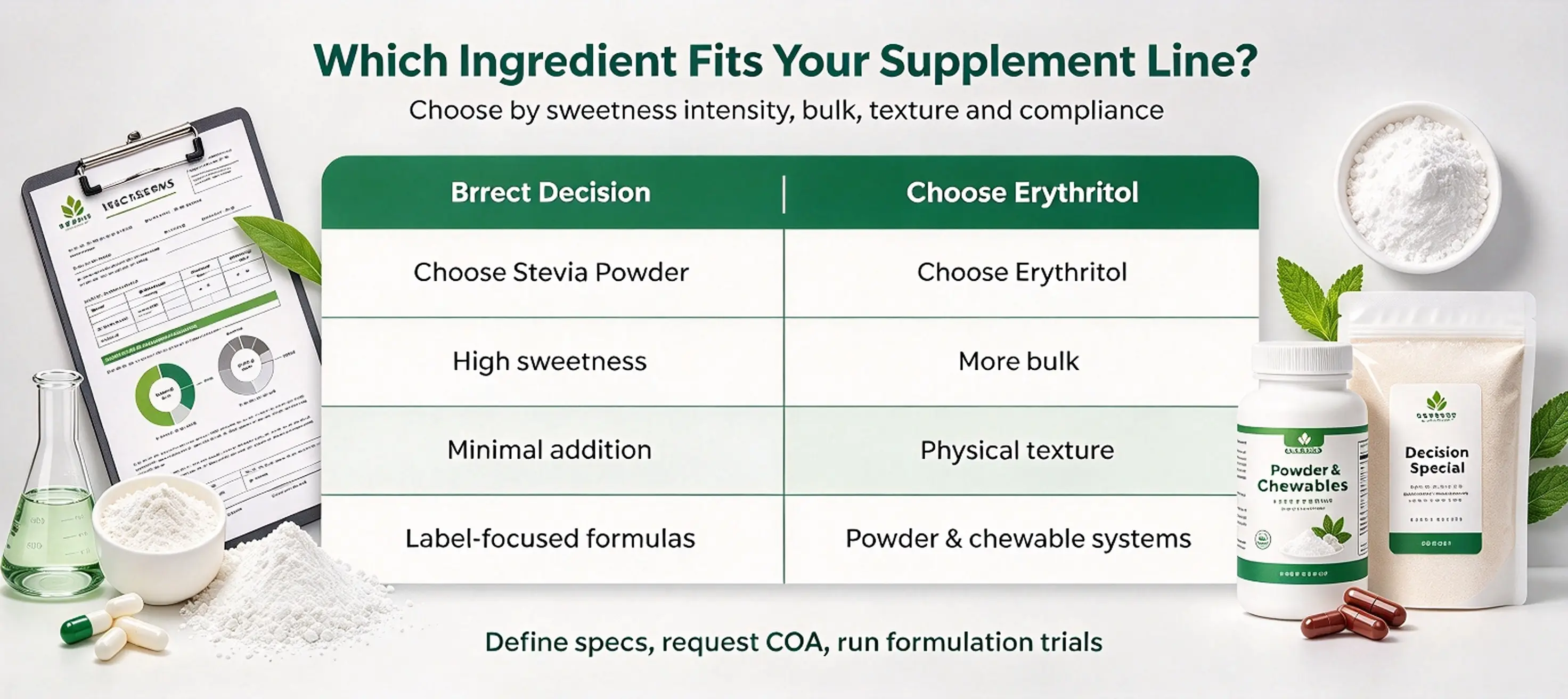
| Formulation factor | Stevia-derived sweetener | Erythritol |
|---|---|---|
| Main role | High-intensity sweetness | Sweetness and bulk |
| Sweetness intensity | Very high for purified steviol glycosides | Closer to sugar |
| Typical use level | Low for high-purity materials | Higher than high-intensity stevia |
| Contribution to powder volume | Limited at low use levels | More substantial |
| Mouthfeel | Depends on grade and formulation | Can provide body and a cooling sensation |
| Taste considerations | Possible bitter or lingering notes | Cooling effect may be noticeable |
| Best selection criterion | Sweetness target and taste profile | Sweetness, bulk, and texture requirements |
These are general formulation differences. Actual performance depends on ingredient grade, concentration, product composition, and processing conditions.
The best choice becomes clearer when the intended product is considered first.
Powdered drink mixes
For a drink mix designed to have a strong sweetness level with minimal added sweetener mass, a suitable stevia-derived sweetener may be appropriate.
Erythritol may be useful when the formula also needs solids and a fuller mouthfeel. However, its cooling sensation and behavior after dissolution should be tested in the final beverage.
Protein and nutrition powders
Protein-based formulations can have bitter, earthy, or other flavor notes that require careful masking. Stevia may contribute sweetness, while erythritol can add sweetness and bulk.
Neither ingredient automatically solves all flavor challenges. The result depends on protein source, flavor system, serving size, and the balance between sweetener and other ingredients.
Gummies and chewable supplements
These products require more than sweetness. Texture, moisture, processing temperature, and the behavior of the complete sweetener system all matter.
Erythritol may contribute solids, but it should not be assumed to reproduce the functional properties of sugar or syrup in every gummy system. Stevia may provide sweetness, but it does not replace the structural role of bulk ingredients.
Capsules and tablets
For conventional capsules, sweetener choice may have little relevance unless the ingredient affects the formulation or the product is intended to be opened and mixed with food or beverages.
For chewable tablets, taste and mouthfeel are more directly relevant. Selection should account for the intended dosage form and manufacturing process.
In some formulations, combining the two can be more effective than relying on either ingredient alone.
Stevia can provide concentrated sweetness, while erythritol contributes bulk and a different sensory profile. A blend may allow the formulator to adjust sweetness intensity while maintaining the desired serving size or mouthfeel.
However, a blend is not automatically superior.
The optimal ratio depends on the product’s target sweetness, flavor profile, physical format, and intended consumer experience. The cooling effect of erythritol may remain noticeable, and stevia’s lingering taste may still require flavor adjustments.
A practical development process is to prepare several pilot formulas, compare them in a blind sensory evaluation, and assess the finished product after processing and storage.
For supplement brands and contract manufacturers, purchasing decisions should be based on a clear specification rather than the ingredient name alone.
For Stevia Powder, ask about:
Botanical source and exact material type
Steviol glycoside profile or purity, where applicable
Sweetness intensity and sensory characteristics
COA and relevant quality documentation
Intended use and market-specific regulatory suitability
For Erythritol, ask about:
Purity and product grade
Particle size and physical appearance
Solubility and performance in the intended formulation
Microbiological and contaminant specifications
COA, packaging, and supply consistency
For both ingredients, request a sample and evaluate it under actual formulation conditions. The ingredient that performs best in a supplier’s demonstration may not perform identically in your own formula.
Regulatory requirements also vary by country and product category. Manufacturers should verify ingredient status, permitted uses, and labeling requirements in each target market before commercialization.
Hunan MT Health Inc. supplies botanical ingredient solutions for food, beverage, and supplement manufacturers. When evaluating a stevia-based ingredient for a new product, B2B buyers should begin by defining the required material type, target sweetness, dosage form, and market.
This makes it easier to assess whether the requested ingredient matches the intended application and to identify the documentation required for technical review.
For manufacturers developing reduced-sugar supplement lines, clear specifications and early sample testing can help streamline product development and purchasing decisions.
Contact Hunan MT Health to discuss Stevia Powder specifications, sample evaluation, and sourcing requirements for your next formulation.
Is stevia sweeter than erythritol?
Purified steviol glycosides are much sweeter than erythritol and sucrose on a weight-for-weight basis. Commercial products labeled “Stevia Powder” can vary, so the exact sweetness depends on the material supplied.
Can stevia replace erythritol in a supplement formula?
Not always. Stevia can provide intense sweetness, but it does not contribute the same amount of bulk. If erythritol is helping provide volume or texture, the formulation may need another ingredient to replace that function.
Can stevia and erythritol be combined?
Yes, they can be evaluated together in suitable formulations. The blend ratio should be determined through sensory testing and physical performance testing in the finished product.
Is all Stevia Powder the same?
No. Stevia leaf powder, crude extracts, and purified steviol glycosides differ in composition, sweetness intensity, and regulatory status. Buyers should confirm the exact ingredient specification before purchasing.
Which sweetener is better for a supplement line?
Stevia-derived sweeteners may be preferable when concentrated sweetness is the main goal. Erythritol may be more suitable when the formulation also needs bulk. For some products, a combination may be worth testing.
Choose Stevia Powder when concentrated sweetness is the priority. Consider erythritol when the formula also needs bulk and mouthfeel. Evaluate both against the finished product’s sensory profile, dosage form, manufacturing process, and regulatory requirements before making a final sourcing decision.
Hunan MT Health ist bestrebt, die Bedürfnisse der Kunden zu verstehen, Marktveränderungen vorherzusehen, innovative Lösungen anzubieten, kreatives Denken und fortschrittliche Technologie einzusetzen, um den Service zu verbessern. Sie sind herzlich eingeladen, unser Unternehmen jederzeit zu besuchen!
Chat
Hinterlassen Sie Ihre Nachricht
Senden Sie Ihre Anfrage


 DE
 EN
 ZH
 AR
 TH
 EN_GB
 DA
 ES