
Onion Powder
Allium cepa L
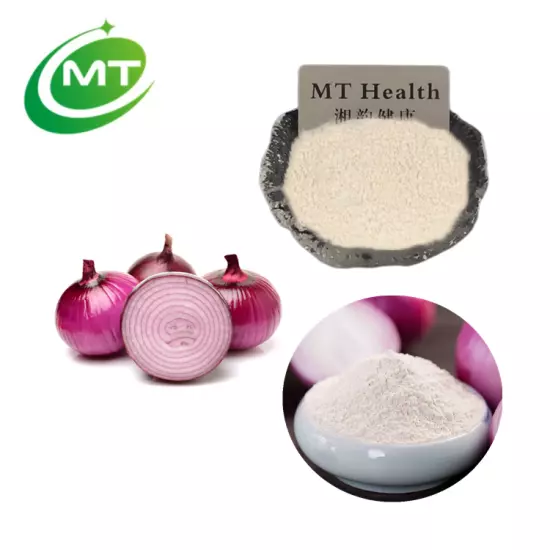
Dried onion
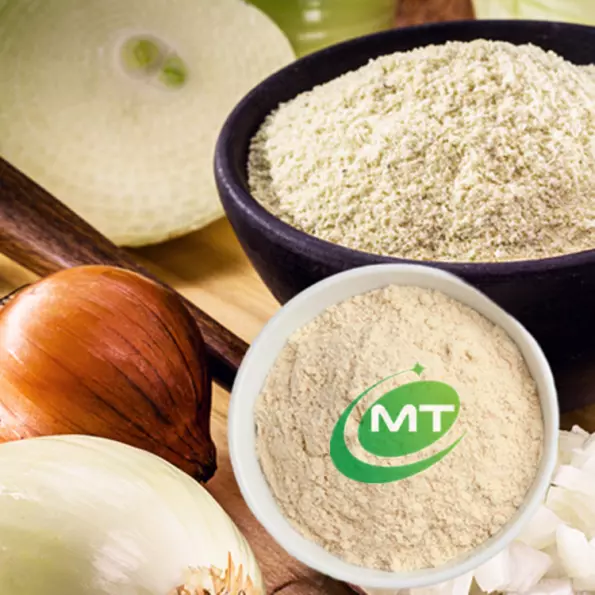
Raw powder
Off-white powder
Onion is one of the most widely used flavor ingredients in the global food industry. From soups and sauces to snacks, seasonings, meat products, and ready-to-eat meals, onion provides a familiar savory character that works across a wide range of cuisines.
Onion Powder offers manufacturers a convenient and consistent way to incorporate onion flavor into commercial food formulations. Produced from dehydrated onion and milled into a fine powder, it can be easily blended with other dry ingredients and incorporated into a variety of food systems.
For food manufacturers, ingredient distributors, seasoning companies, and private-label brands, Onion Powder can provide several practical advantages: convenient handling, concentrated onion flavor, formulation flexibility, easy dry blending, and broad application potential.
At Hunan MT Health, we supply Onion Powder for B2B customers looking for reliable plant-based food ingredients for seasoning, food processing, sauces, snacks, bakery products, instant foods, and other commercial applications.
Onion Powder is a dried and milled ingredient made from onion, commonly derived from Allium cepa. Fresh onions contain a high amount of water, so dehydration significantly reduces their moisture content and converts them into a more stable ingredient format.
The resulting powder retains the characteristic flavor and aroma associated with onion, although drying and processing can influence its sensory profile.
Onion’s distinctive flavor is closely associated with sulfur-containing compounds and their transformations during cutting and processing. Research has identified compounds such as cysteine sulfoxides, thiosulfinates, sulfides, and disulfides among the chemical components contributing to onion’s characteristic sensory properties.
Depending on the raw material and processing method, Onion Powder can vary in:
Color
Aroma
Pungency
Sweetness
Particle size
Moisture
Flowability
Flavor intensity
For B2B applications, these characteristics should be matched to the requirements of the finished product.
Fresh onions are an important culinary ingredient, but they are not always the most convenient choice for industrial food production.
Fresh onions contain substantial moisture and require additional handling, preparation, storage, and processing before they can be incorporated into a finished food.
Dehydrated onion ingredients have long been used in manufactured foods. USDA materials describe dehydrated onions as ingredients used across a broad range of processed foods, including sauces and meat products.
For manufacturers, Onion Powder can simplify production by providing a ready-to-use dry ingredient.
Key advantages include:
Easy storage: Powdered ingredients generally require less handling than fresh vegetables.
Convenient transportation: Removing much of the original water content reduces the bulk associated with fresh onions.
Easy dosing: Powder can be weighed and incorporated according to a defined formulation.
Dry blending: Onion Powder can be combined with salt, herbs, spices, vegetable powders, and other powdered ingredients.
Consistent formulation: A defined product specification can help manufacturers maintain similar flavor characteristics from batch to batch.
| Items | Specifications | Test Methods |
| Appearance & Color Odor & Taste
Mesh Size |
Fine off-white powder
Characteristic NLT 90% through 60 mesh |
Visual
Organoleptic 60 Mesh Screen |
| Moisture Content
Ash Content |
NMT 12.0%
NMT 12.0% |
5g / 105℃ / 2hrs
2g / 525℃ / 3hrs |
| Total Plate Count
Total Yeast & Mold |
NMT 100,000cfu/g
NMT 10,000cfu/g |
|
| Shelf Life | 2 years | |
| Remarks | Store in a well-closed container away from moisture, heat and strong sun.
Packing: Fiber drums and two plastic-bags inside. 25kg/drum. |
|
These three ingredients can serve different manufacturing purposes.
| Feature | Onion Powder | Onion Flakes | Fresh Onion |
|---|---|---|---|
| Format | Fine powder | Dried pieces | Fresh vegetable |
| Handling | Easy | Easy | More preparation required |
| Dry blending | Excellent | Good | Not suitable |
| Flavor distribution | High | Moderate | Depends on processing |
| Storage convenience | High | High | Lower |
| Suitable for instant mixes | Excellent | Good | Limited |
| Visible onion pieces | No | Yes | Yes |
Onion Powder is generally the better choice when a manufacturer wants a consistent onion flavor distributed throughout a dry formulation.
Onion Flakes may be preferable when visible onion pieces are part of the desired product appearance.
Onion Powder is primarily used as a flavoring and food ingredient, but it can also contribute to the overall sensory characteristics of a formulation.
Flavor Enhancement
The most important function is delivering onion flavor.
Onion can add depth to savory products and work as either a primary or supporting flavor.
Aroma
Volatile compounds associated with onion contribute to its characteristic aroma. Processing conditions can influence the retention and transformation of these compounds.
Flavor Layering
Onion works particularly well with other savory ingredients.
For example:
Onion + Garlic creates a classic savory base.
Onion + Black Pepper works well in meat and snack applications.
Onion + Tomato is suitable for sauces and seasoning systems.
Onion + Cheese can create familiar snack and dairy flavor profiles.
This makes Onion Powder useful as part of a broader flavor architecture rather than simply a standalone seasoning.
Onion is more than a flavor vegetable. It contains carbohydrates, dietary fiber, minerals, flavonoids, and various sulfur-containing compounds.
Scientific literature has identified compounds including quercetin and quercetin glycosides, cysteine sulfoxides, other organosulfur compounds, phenolic compounds, and polysaccharides in onion. Their concentrations can vary between onion varieties and growing conditions.
However, it is important to distinguish between Onion Powder as a food ingredient and standardized Onion Extract.
A conventional Onion Powder should not automatically be marketed as a high-potency source of a specific bioactive compound unless the product has been analytically standardized for that compound.
For food manufacturers, this distinction helps ensure that product descriptions and marketing claims remain technically accurate.
Seasoning is one of the most straightforward applications.
Onion Powder can be used in customized seasoning blends for:
Potato chips
Tortilla chips
Popcorn
Crackers
Nuts
French fries
Snack pellets
Savory biscuits
It can be combined with salt, herbs, spices, and other natural flavor ingredients to create different regional profiles.
Onion is a fundamental flavor component in many savory sauces.
Onion Powder can be used in:
Tomato sauces
Pasta sauces
BBQ sauces
Dipping sauces
Gravy mixes
Soup bases
Marinades
Cooking sauces
The powdered format is particularly convenient for instant sauce mixes and dry sauce bases.
Convenience foods require ingredients that are easy to standardize and process.
Onion Powder can be incorporated into:
Instant soup mixes
Cup soups
Noodle seasoning
Ready-to-eat meals
Dehydrated meal kits
Instant gravy
Savory powder mixes
It can provide a recognizable savory foundation without requiring fresh onion preparation during manufacturing.
Onion is widely associated with savory meat preparations.
Potential applications include:
Sausages
Meatballs
Burgers
Meat marinades
Meat seasoning
Plant-based burgers
Plant-based meat alternatives
Onion Powder can be combined with garlic, pepper, herbs, and other seasonings to create a more complete savory profile.
Although onion is primarily associated with savory foods, it also has applications in bakery.
Potential products include:
Savory crackers
Bread
Breadsticks
Pretzels
Savory biscuits
Stuffed breads
Seasoned bakery snacks
The dosage can be adjusted depending on whether onion is intended to be a dominant flavor or a background note.
The global snack market provides many opportunities for Onion Powder.
It can be incorporated into seasoning systems for:
Potato chips
Corn snacks
Extruded snacks
Popcorn
Crackers
Roasted nuts
Savory snack mixes
For these products, particle size and flowability can be important because the powder needs to distribute evenly across the food surface.
When purchasing Onion Powder in bulk, food manufacturers should look beyond the price per kilogram.
The most appropriate product depends on the intended application.
Important purchasing considerations include:
Botanical source: Confirm the onion species and raw material.
Flavor profile: Evaluate pungency, sweetness, aroma, and overall sensory characteristics.
Color: Powder color can influence the appearance of the finished product.
Particle size: This affects blending, dispersion, and mouthfeel.
Moisture: Important for storage stability and powder handling.
Microbiological quality: Particularly important for commercial food applications.
Packaging: Packaging should protect the powder from moisture and contamination.
Batch consistency: Consistent specifications are important for large-scale production.
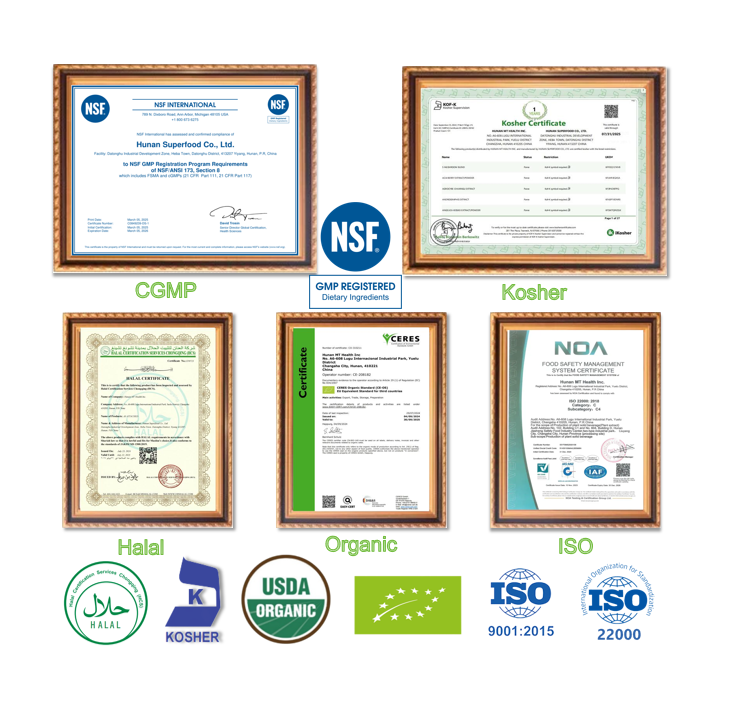
Documentation: Depending on the target market, buyers may request COA, specifications, microbiological results, heavy-metal testing, pesticide information, allergen statements, and other compliance documents.
The quality of a dehydrated onion ingredient depends partly on how the raw material is processed.
Drying conditions can influence:
Color
Aroma
Pungency
Moisture
Browning
Flavor retention
USDA Agricultural Research Service research on dehydrated onions has examined how drying conditions affect drying rate and quality characteristics such as pungency and color.
This is why B2B buyers should evaluate both the raw material and the processing specification when selecting an Onion Powder supplier.
A sample test in the intended application is recommended before large-scale purchasing.
Hunan MT Health try best to understand customer’s needs, predict the market changes, put forward innovative solutions, Adopt creative thinking and advanced technology to improve better service. You are welcome to visit our company any time!
Chat
Leave Your Message
Send your inquiry


 EN
EN  ZH
ZH  AR
AR  TH
TH  EN_GB
EN_GB  DA
DA  DE
DE  ES
ES 
